Last Updated on September 28, 2026
Estimated reading time: 4 minutes
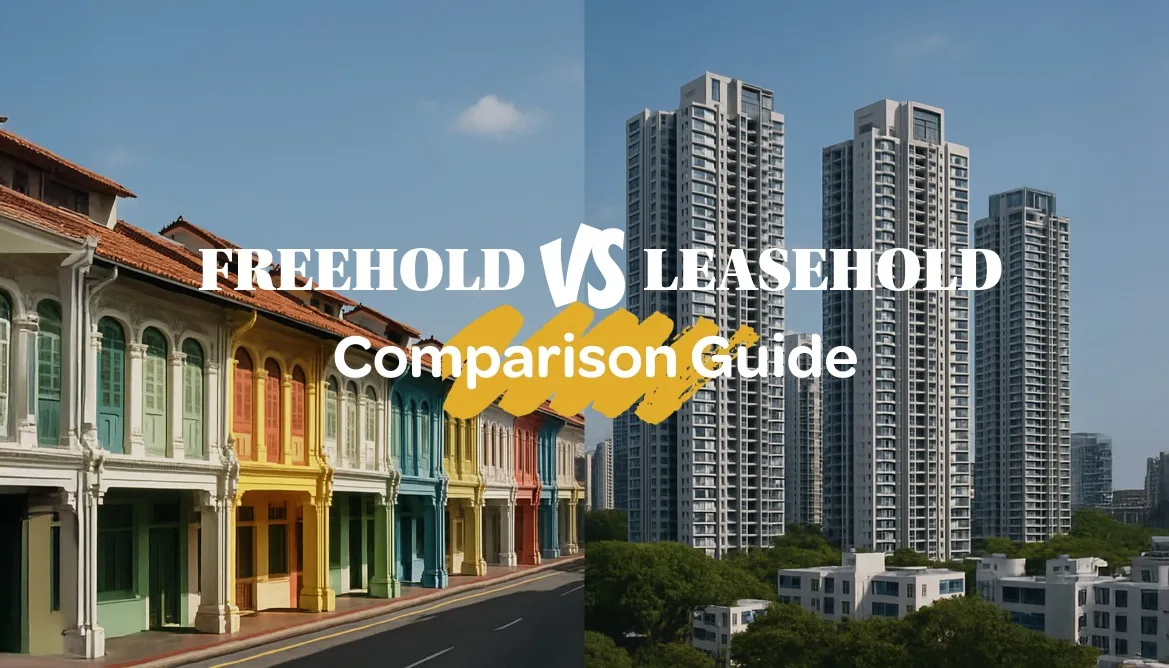
When considering Freehold vs Leasehold, freehold often “feels” safer, while leasehold looks cheaper. However, when comparing Freehold vs Leasehold Properties, returns hinge on location, timing, and goals—not tenure labels. This guide explains when freehold premiums make sense and when well-picked leasehold units actually yield higher risk-adjusted returns.
Freehold vs Leasehold Properties: What Really Differs
Freehold Properties offer perpetual ownership rights, seamless inheritance, and tenure security. Owners enjoy absolute flexibility in property decisions. (See the breakdown of types of housing in Singapore for a fuller context.)
Leasehold Properties operate under 99-year or 999-year lease structures. While entry prices are lower, lease-decay and renewal uncertainties affect long-term value.
Capital Appreciation: Premiums Aren’t Uniform
- Freehold properties often trade at 15–25% premiums over leasehold, but the actual gap varies by location.
- In core districts, premiums can be much higher. In suburban areas, premiums narrow significantly.
- Over long periods, some leasehold properties have even outperformed freehold counterparts.
For example, my Singapore Property Selling Timeline shows how tenure interacts with sales velocity and buyer demand.
Quick Comparison
| Factor | Freehold | Leasehold (99y) |
| Entry Price | Higher (premium) | Lower (accessible) |
| Liquidity in Downturns | Generally stronger | Varies by location |
| Upside in Recoveries | Steady | Often higher (lower base) |
| Financing Sensitivity | Lower | Higher as the lease shortens |
| Estate Planning | Simple | Depends on the remaining lease |
Rental Yields: Mind the Math, Not the Myth
Tenants don’t pay extra just because a unit is freehold—they pay for location, layout, and convenience. Yield uplifts on freehold rarely offset the larger capital outlay.
For a broader market context, check the prime rental growth data.
Lease Decay & Bankability: The 60-Year Watch
Lease decay risk becomes material around the 60-year remaining lease threshold. At this point:
- Buyer perception begins to soften.
- Banks adjust loan-to-value (LTV) ratios and shorten loan tenures.
- Resale liquidity weakens.
Above ~80 years remaining, discounts to freehold are minimal. Below ~60, pricing resistance escalates sharply unless the location is exceptional.
For investors, this is as much about financing policy as it is about market sentiment—similar to issues you’d weigh when reviewing common tenancy clauses or stamp duty obligations.
Strategy Matrix: Match Tenure to Your Goals
- 3–7 years (growth focus): A well-located leasehold can shine with lower entry costs and leverage.
- 15+ years (certainty/legacy): Freehold reduces lease-decay anxiety and simplifies estate planning.
- Income focus: Choose based on yield and future capex, not tenure bias.
Location Playbooks
- Prime districts: Freehold premiums are justified by scarcity and consistent demand (Singapore Districts guide).
- Emerging areas: Leasehold often captures regeneration upside with smaller capital outlay.
- Suburban family nodes: Premiums are milder; yield-seekers may prefer leasehold.
Advanced Portfolio Tactics
Smart investors mix tenures to balance liquidity, volatility, and horizon risk.
- Spot mispricing opportunities when freehold premiums shrink excessively or balloon too much.
- Incorporate tenure into broader portfolio planning to diversify risk.
Location, Lifestyle & Financing Considerations
Tenure is only part of the equation. Freehold properties in Singapore are concentrated in mature, central districts such as Orchard, Novena, and River Valley, where land scarcity and proximity to schools, retail, and transport keep demand resilient across market cycles. Buyers should weigh whether a freehold premium is really buying perpetual tenure, or simply paying for a well-established location that a comparable leasehold nearby could also offer.
The lifestyle case matters too. Freehold condos in these enclaves tend to appeal to families who see the home as a multi-generational asset, valuing the permanence and established community over the novelty of newer leasehold launches. For sellers, this narrative around heritage neighbourhoods and long-term familiarity can be a meaningful differentiator when marketing a unit.
Financing frameworks apply regardless of tenure. Even with perpetual ownership, freehold buyers still need to work within TDSR limits, loan-to-value caps, and ABSD rules. Proper financial planning ensures the security of freehold ownership doesn’t come at the cost of over-leveraging, so tenure remains an advantage rather than a strain on affordability.
Due Diligence Checklist
- Title & remaining lease (INLIS)
- Bank financing terms at the current tenure
- Net yield vs future capex (M&E, façade works, lifts)
- Comparable sales velocity and demand profile
- Estate-planning implications
Conclusion
There’s no universal winner. Let goals, numbers, and location decide. Pay a freehold premium only when it delivers superior returns, liquidity, or risk reduction—otherwise, pick the leasehold that compounds better for your plan.
Ready to weigh tenure against numbers? Contact me today for a data-driven property plan aligned to your goals.
Frequently Asked Questions
Premiums vary by location and property type. Some leaseholds outperform over practical holding periods.
Perception and financing constraints tend to bite as the remaining lease dips toward ~60 years.
Yes. Some reduce LTV or shorten loan tenure, which impacts affordability and resale.
It depends on net yield. Location and layout usually drive rents more than tenure.
Freehold often suits long-term horizons and estate planning—if the price premium aligns with your objectives.