Last Updated on September 2, 2026
Singapore’s population in 2025 reached 6.11 million as at June 2025, a 1.2% rise from the previous year. This growth mainly reflects a larger non-resident population, while the citizen population rose modestly and the Permanent Resident (PR) population remained broadly stable. Each shift ripples through housing demand, rental occupancy, resale activity, and investment sentiment. These dynamics are integral to understanding the Singapore Population 2025: Property Market Outlook & Housing Trends.
Quick Summary: Singapore Population 2025 and Property Market Outlook
For buyers, landlords, and investors, the key point is simple: population growth is not just about the headline number. The composition of that growth matters.
- Total population: Singapore’s population reached 6.11 million in June 2025, setting a new high.
- Non-resident population: Non-residents made up about 31.2% of the total population, supporting rental demand from foreign workers, professionals, students, and dependants.
- Resident base: Citizens rose modestly while PR numbers stayed broadly stable, reinforcing long-term owner-occupier depth rather than speculative demand alone.
- Household formation: Smaller households continue to support demand for efficient layouts, right-sized homes, dual-key units, and integrated developments.
- 2026 market context: Private home prices and rents continued to edge up in 2Q 2026, while HDB resale prices moderated for a second straight quarter, giving buyers a more balanced market to assess.
Table of Contents
- Population Snapshot: Singapore Population Statistics 2025
- Non-Resident Workforce & Rental Demand
- Smaller Households & Evolving HDB and Condo Layouts
- New PRs & Citizens Boost the Owner-Occupier Base
- Master Plan 2025, Housing and Job-Housing Balance
- 2026 Market Update: Rents, Resale Prices, Vacancy and Supply
- Key Takeaway
- Frequently Asked Questions
Population Snapshot: Singapore Population Statistics 2025
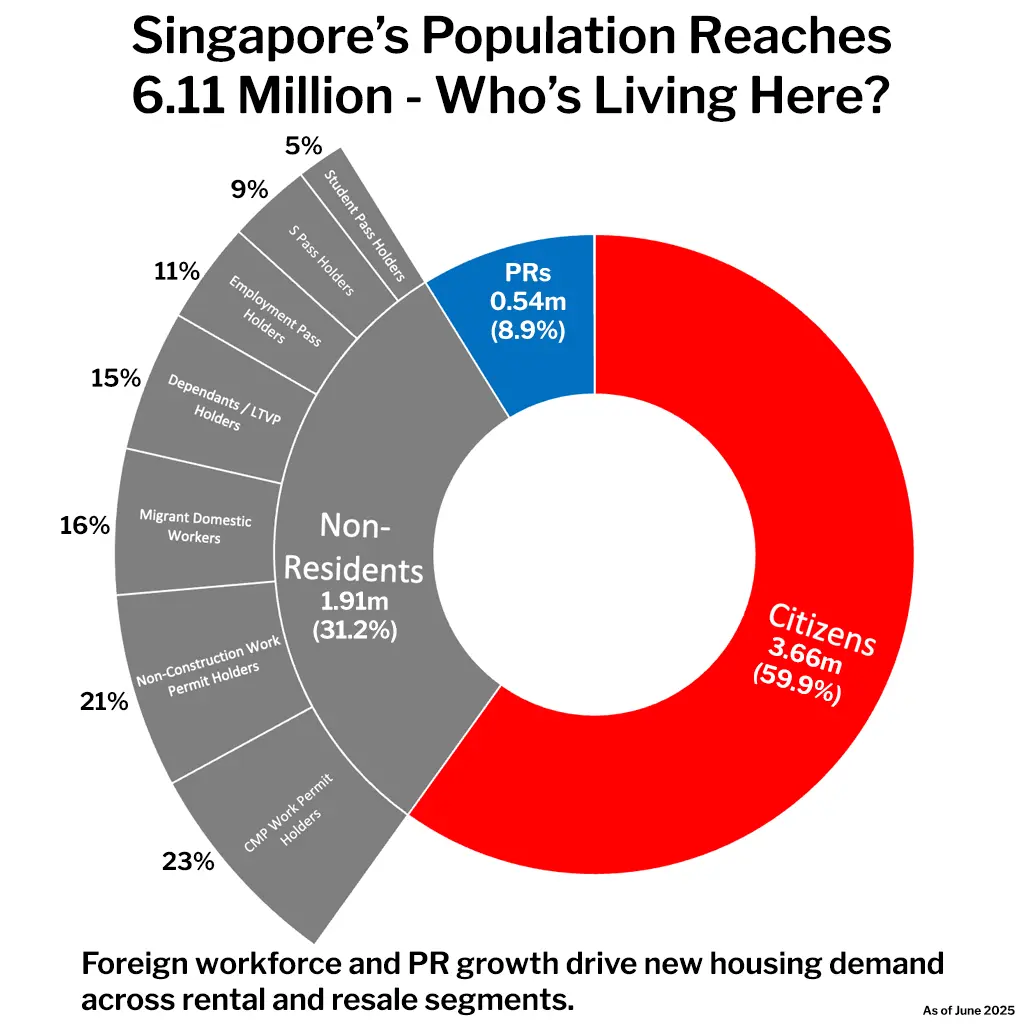
The 6.11 million headline figure becomes more useful when broken down into the people who create different types of housing demand. Singapore had about 3.66 million citizens, 0.54 million Permanent Residents, and 1.91 million non-residents as at June 2025. Citizens and PRs form the core resident base for Housing & Development Board (HDB) flats and owner-occupied private homes, while non-residents mainly influence rental demand across private homes, HDB rooms and flats, and selected co-living formats.
| Demographic signal | Verified statistic | Likely property impact | Buyer or investor takeaway |
|---|---|---|---|
| Total population growth | 6.11 million as at June 2025, up 1.2% year-on-year | Supports broad demand across rental, resale, and new-launch segments | Look beyond the headline and study where jobs, transport, and amenities are growing |
| Non-resident population | About 1.91 million, or 31.2% of Singapore’s total population | Supports tenant demand near employment nodes, education clusters, and city-fringe locations | Landlords should prioritise accessibility, unit efficiency, and tenant pool depth |
| Citizen and PR base | Citizens rose modestly to about 3.66 million; PRs remained broadly stable at about 0.54 million | Provides a steady owner-occupier base for HDB resale flats and mass-market condominiums | Owner-occupier demand remains important even when investor sentiment shifts |
| Smaller households | Resident households averaged 3.06 people in 2025 | Raises demand for compact, efficient, flexible, and senior-friendly layouts | Right-sizing and layout quality can matter as much as floor area |
| 2026 market indicators | Private residential rents rose 0.7% in 2Q 2026; private home vacancy reached 6.4%; HDB resale prices slipped 0.3% | Points to a market that is resilient but more selective | Pricing discipline, holding power, and location fundamentals are still essential |
Non-Resident Workforce & Rental Demand
With the non-resident segment at roughly 1.91 million people, or about 31.2% of Singapore’s total population as at June 2025, rental demand remains supported by the foreign workforce and student population. This includes work permit holders, S Pass holders, Employment Pass holders, students, and dependants, each with different budgets and location preferences.
Many of these non-resident workers support major infrastructure projects such as Changi Terminal 5 and MRT construction, which can help underpin rental demand near employment and transport nodes. For landlords, this is why tenant depth often improves around practical, well-connected areas rather than only in prime districts.
Rentals are especially buoyant in areas close to industrial/logistics hubs, city-fringe neighbourhoods, and education clusters. Tampines and Pasir Ris can benefit from aviation, logistics, and Changi-related access; Jurong and Clementi remain relevant for business and education nodes; while Rest of Central Region (RCR) areas such as Queenstown, Toa Payoh, Kallang, and Paya Lebar appeal to tenants who want city-fringe convenience without always paying Core Central Region (CCR) rents. These supply-demand dynamics align with recent resets in Singapore’s rental market trends that highlight occupancy stability even amid economic uncertainty.

Smaller Households & Evolving HDB and Condo Layouts
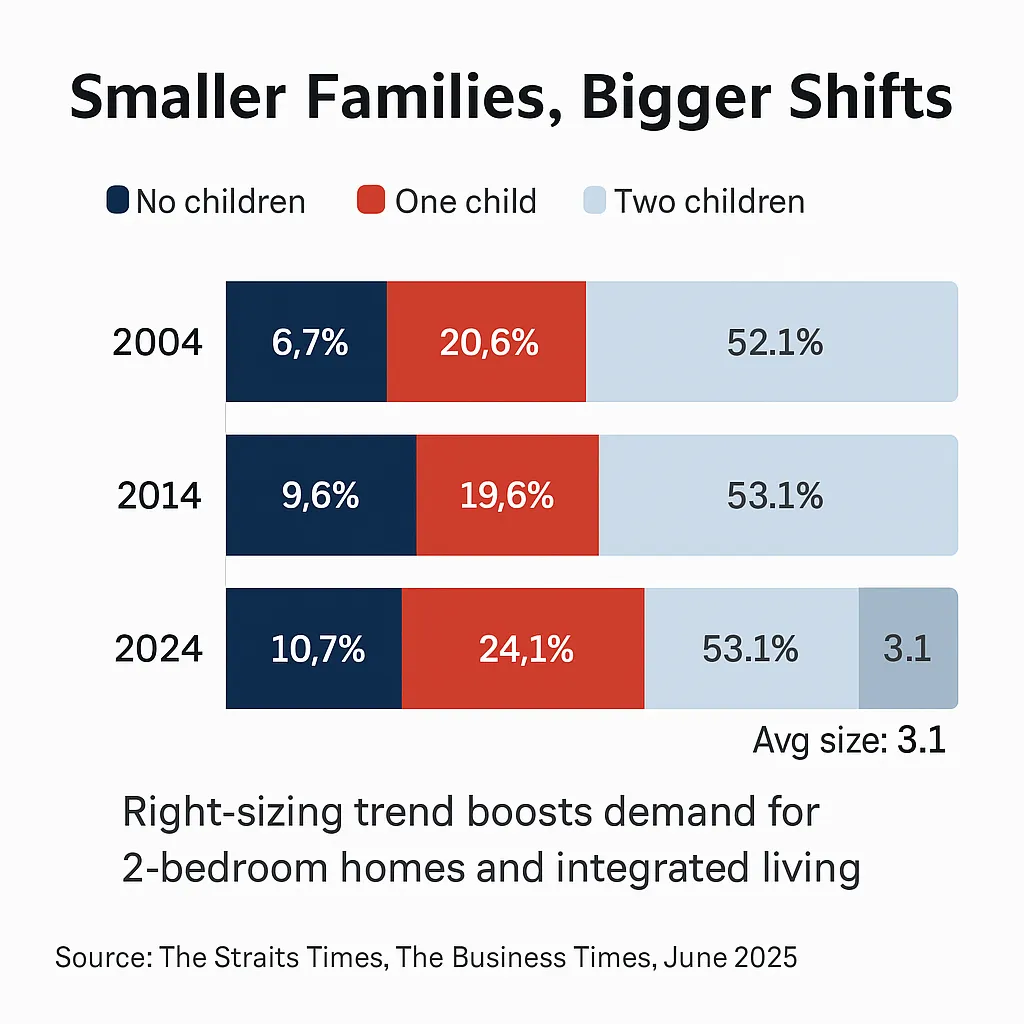
Singapore population growth is important—but equally telling is how households are changing. More singles and smaller families are changing demand patterns: resident households averaged 3.06 people in 2025, while among ever-married resident females aged 40–49, 13.8% had exactly three children and 4.1% had four or more in 2024.
That shift is driving preference for compact, efficient living spaces. Developers are responding with layouts like dual-key units, integrated developments, and senior-friendly designs—a trend I covered in my article on compact homes and integrated developments in Singapore.
For HDB buyers, smaller household size can support demand for well-located 3-room, 4-room, and right-sized flats near transport and amenities. For condo buyers, it sharpens the focus on usable layouts, storage, work-from-home corners, and developments that combine daily convenience with efficient floor plans. In a higher-price environment, the smartest homes are often not just bigger—they are better planned.
New PRs & Citizens Boost the Owner-Occupier Base
In 2024, Singapore granted 22,766 citizenships and 35,264 permanent residencies, supporting a steady resident base for long-term housing demand. These grants do not automatically translate into immediate home purchases, because some new citizens and PRs may already have been living, renting, or owning homes in Singapore. But they do add depth to the resident pool that supports housing decisions over time.
Many long-term residents eventually consider HDB resale flats or mass-market condominiums in the Outside Central Region (OCR) and Rest of Central Region (RCR). OCR towns such as Tampines, Pasir Ris, Woodlands, Sengkang, Punggol, Jurong, and Bukit Batok can appeal to families looking for space and connectivity, while selected RCR locations offer a balance between city access and relative affordability.
This steady inflow helps stabilise the owner-occupier layer even as speculative interest moderates. It also ties into the major urban planning shifts in the Urban Redevelopment Authority’s (URA) gazetted Master Plan 2025, Singapore’s official land-use blueprint for the next 10 to 15 years, which aims to bring homes, jobs, amenities, transport and community spaces closer together.

Master Plan 2025, Housing and Job-Housing Balance
Master Plan 2025 matters because demographic growth needs land-use planning to work. As Singapore’s official medium-term land-use blueprint, it guides where homes, jobs, transport links, green spaces, and community amenities can grow over the next 10 to 15 years.
For property decisions, this means buyers should watch not only today’s MRT stations and malls, but also future employment nodes, transport upgrades, and estate rejuvenation plans. A home near expanding job clusters or better transport links can enjoy more resilient demand, whether the exit strategy is resale, leasing, or long-term family use.
2026 Market Update: Rents, Resale Prices, Vacancy and Supply
The 2025 population data gives the demographic foundation, while 2026 property indicators show how that demand is showing up in the market. In the private residential segment, the overall private home price index rose 0.5% quarter-on-quarter in 2Q 2026, following a 0.9% increase in the previous quarter. Private residential rents also rose 0.7% in 2Q 2026, suggesting that rental demand remains present, though landlords still need to price realistically.
Vacancy is another important signal. The vacancy rate for completed private residential units, excluding Executive Condominiums, increased to 6.4% at the end of 2Q 2026 from 6.2% in the previous quarter. This does not remove the rental-demand story, but it does make unit selection more important. Tenants have choices, so accessibility, condition, layout, furnishing quality, and asking rent can determine how quickly a unit moves.
In the HDB resale market, the HDB Resale Price Index stood at 202.8 in 2Q 2026, down 0.3% from 1Q 2026. That followed a 0.1% decline in 1Q 2026, marking a more measured phase after several years of strong gains. At the same time, approved applications to rent out HDB flats rose to 10,002 in 2Q 2026 from 9,535 in 1Q 2026, showing that rental activity remained active even as resale prices moderated.
For owner-occupiers, this is a healthier environment to compare options carefully instead of rushing into the market. For investors, it reinforces the need to separate population-supported demand from overpaying for weak yields. The right property still needs a strong tenant pool, sensible entry price, manageable financing, and a realistic view of supply.
How Singapore Population Growth Supports Rental and Resale Demand
Short-term factors like interest rates and global headwinds make headlines—but demographics set the foundation. With continued job creation and infrastructure build-out, both the rental and resale markets in Singapore are positioned for resilience, though the pace of price growth can vary sharply by segment.
As households get smaller and as the workforce grows more diverse, property supply is evolving too. Expect more co-living models, integrated developments, flexible layouts, and neighbourhoods built around shared amenities. In CCR locations, tenant demand is often tied to expatriate professionals and premium lifestyle appeal. In RCR locations, the draw is city-fringe convenience. In OCR locations, value, space, family needs, and access to decentralised employment nodes often matter more.
Key Takeaway
Population growth isn’t simply a statistic—it’s a strategic insight. Understanding who lives in Singapore, how they live, and where they work gives you the edge when choosing your next home or investment.
Whether you’re planning an upgrade or building a rental portfolio, these demographic signals point to sustained depth in the market—for the long haul. But the opportunity is not evenly spread. The strongest decisions will still come from matching demographic demand with the right location, layout, price, and holding strategy.
Contact me today to discuss how Singapore’s demographic shifts can shape your next property move.
Frequently Asked Questions (FAQ)
What does the 6.11 million population mean for the property market?
It means Singapore has a deeper base of job-holders, tenants, and prospective owners, but the composition matters. The 2025 increase was mainly supported by non-resident growth, while citizens rose modestly and PR numbers remained broadly stable. That affects rental demand, HDB resale demand, private condo leasing, and long-term owner-occupier depth in different ways.
Why does shrinking household size matter?
Smaller households create higher demand for compact units, dual-key layouts, senior-friendly homes, and integrated living. For buyers, this means layout efficiency, storage, and proximity to amenities can be just as important as headline floor area.
Where is rental demand strongest now?
City-fringe zones, industrial-adjacent precincts, and areas near education hubs remain in focus for steady rental demand. Examples include Tampines and Pasir Ris for aviation and logistics access, Jurong and Clementi for business and education nodes, and selected RCR locations such as Queenstown, Toa Payoh, Kallang, and Paya Lebar for city-fringe convenience.
How do new PRs and citizens affect housing demand?
They strengthen the resident base over time—particularly for HDB resale and mass-market condos—providing a stable buyer pool even when investment sentiment shifts. The impact is gradual rather than automatic, because new citizenships and PR grants do not always mean immediate home purchases.
How does Singapore population growth affect HDB resale prices?
Population growth supports underlying housing demand, but HDB resale prices also depend on affordability, supply, mortgage conditions, BTO options, policy settings, and buyer confidence. In 2Q 2026, HDB resale prices moderated by 0.3%, showing that demographic demand does not remove the need for price discipline.
Does non-resident growth affect condo rents?
Yes, especially in locations preferred by expatriate professionals, foreign students, and workers who need access to employment nodes. Non-resident growth can support condo rents, but vacancy, new completions, unit condition, and asking rent still determine leasing performance.
Which regions benefit from OCR and RCR demand?
Outside Central Region (OCR) demand is often supported by affordability, family-sized homes, and access to regional centres, while Rest of Central Region (RCR) demand is supported by city-fringe convenience. Towns and districts near MRT lines, schools, business parks, healthcare nodes, and lifestyle amenities tend to be more resilient.
Does population growth guarantee price increases?
Not on its own. Price growth still needs job creation, infrastructure upgrades, supply control, affordability, financing conditions, and buyer confidence to work together. Population is the foundation, but the property decision still comes down to fundamentals.