Last Updated on September 2, 2026
Singapore New Launch Property Outlook 2026 — Updated Mega Guide
September 2026 update
The original outlook, revisited
This guide was first published in late 2025, when many developments were still known only by their Government Land Sales or redevelopment-site names. It has now been refreshed with confirmed project names, launch developments and links to my detailed reviews.
Editorial note: I have retained the original market thesis and Top 10 forecast so readers can judge the reasoning in its proper context. Confirmed information added later is clearly presented as an update rather than quietly rewritten with hindsight.
2026 Launches: From GLS Names to Confirmed Projects
The table below connects the early site names used in the original outlook with the projects buyers now recognise. Where I have published a dedicated review, the project name links directly to the full analysis.
| Original working name | Confirmed project | Update |
|---|---|---|
| Former Thomson View | Thomson Reserve | Updated project details, site plan and buyer analysis available. |
| River Valley Green Parcel B | River Modern | Post-launch review covers its strong take-up and remaining-unit considerations. |
| Bayshore Road GLS | Vela Bay | Full location, pricing and buyer-fit review published. |
| Media Circle Parcel A GLS | Hudson Place Residences | Post-launch analysis examines demand and Media Circle’s maturity. |
| Holland Link GLS | Amberwood at Holland | Pre-launch family-buyer review published. |
| Lakeside Drive GLS | Lucerne Grand | Pre-launch review covers MRT convenience, JLD potential and trade-offs. |
| Newport development | Newport Residences | Dedicated 2026 buyer and investor review published. |
| Marina View white site | W Residences Marina View | Branding, positioning and buyer-fit analysis published. |
2026 is shaping up to be one of the most important launch years of the decade — not because there are “many projects”, but because of how supply, demand and buyer behaviour are aligning after a record-setting 2025. Interest rates have eased back towards post-COVID lows, developers are still bidding confidently for GLS land, and Singapore continues to prove itself as a safe haven for both local and overseas capital.
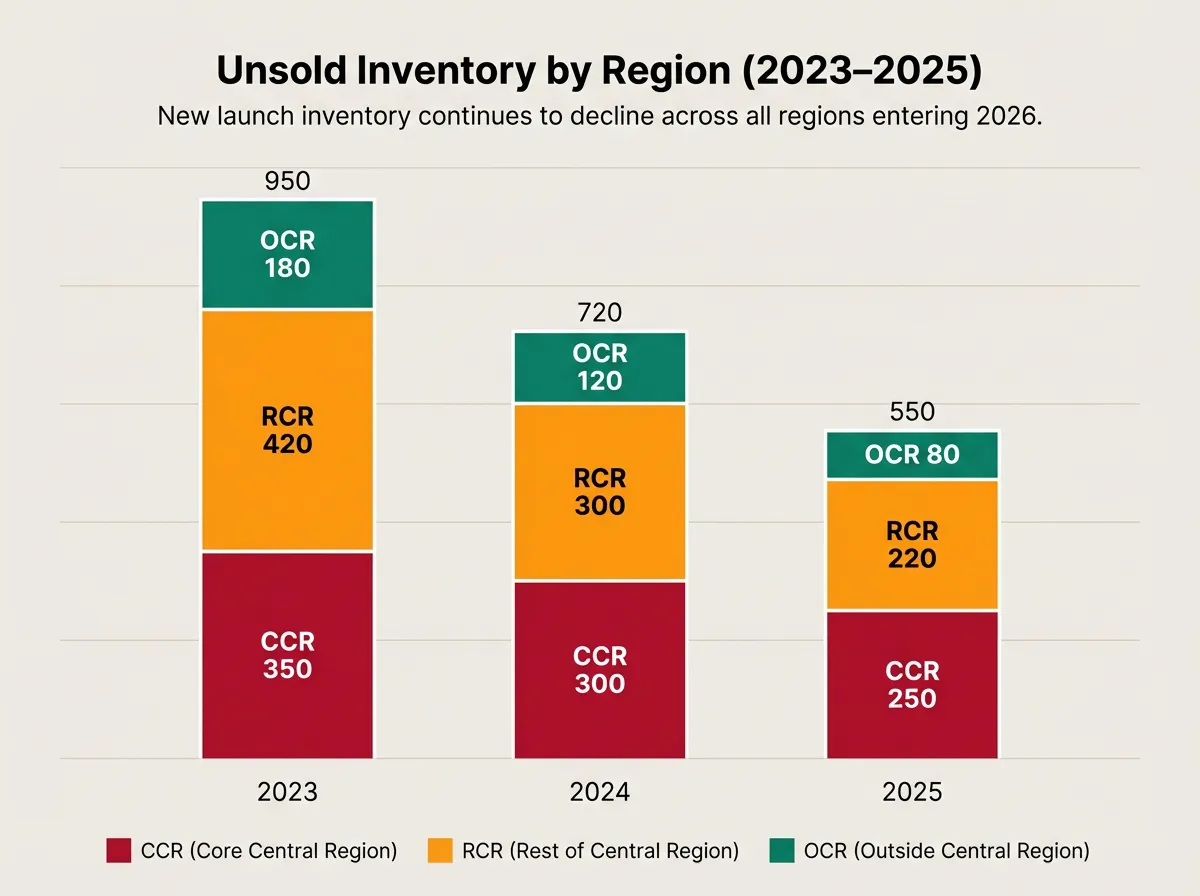
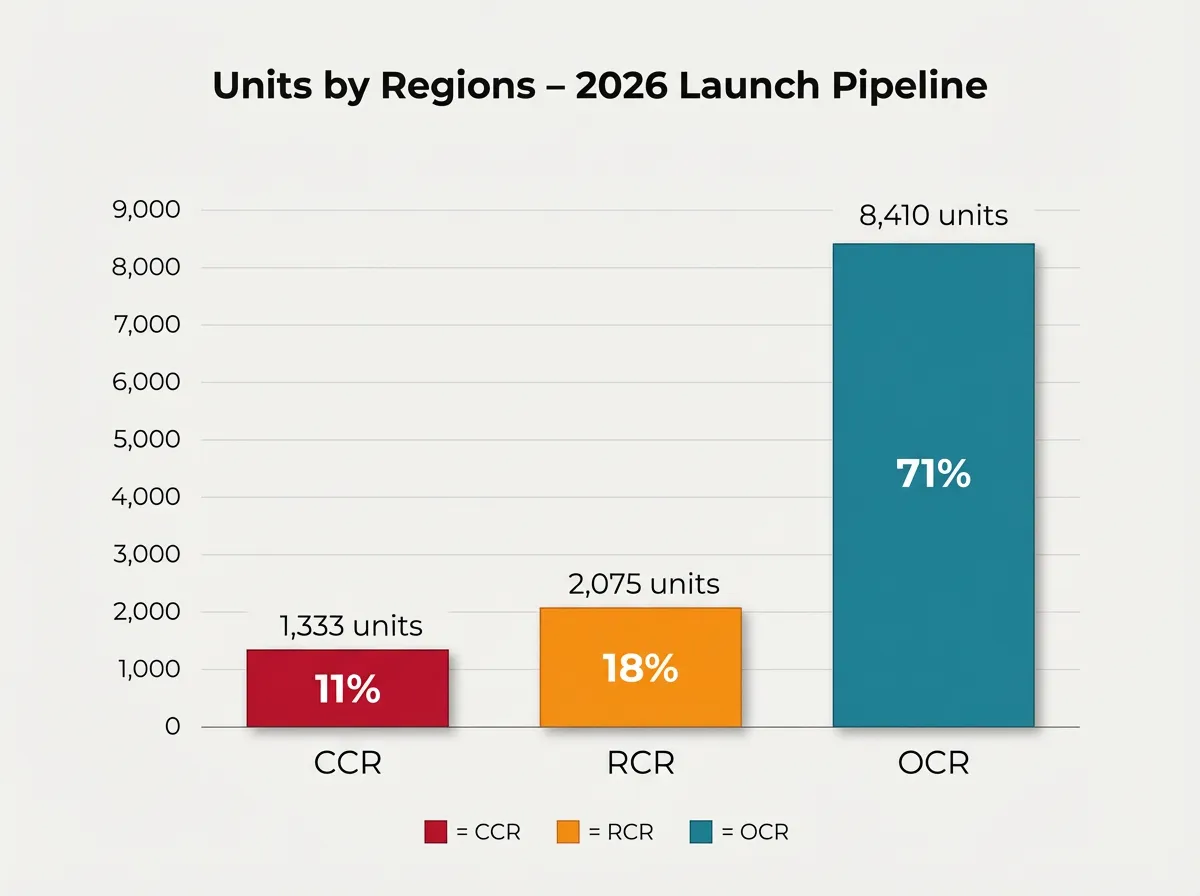
At the same time, unsold inventory is uneven. OCR is almost cleared out, RCR is tight but District 5 and the central fringe still carry meaningful stock, and CCR launches — while healthy — tend to sell gradually over a longer window. Against this backdrop, the 2026 new launch pipeline of around 11,818 units across 24 projects is coming into focus.
For readers who may be unfamiliar with how Singapore is divided by regions and districts, the Singapore districts and regions guide provides a clear overview of where the CCR, RCR and OCR regions are located and which districts fall under each.
This Mega Guide takes a data-backed look at 2026’s new launch market, building on 2025 performance, GLS tender results, unsold inventory, transformation zones and income trends. It also highlights the Top 10 projects to watch and what buyers can realistically expect in the year ahead.
Table of Contents
- September 2026 Update
- What 2025 Taught Us About Buyer Behaviour
- Unsold Inventory Snapshot (Q4 2025)
- Why 2026 Is a Pivotal Year
- 2026 Pipeline Overview by Region
- Original Price Expectations for 2026
- Top 10 New Launch Projects to Watch
- Where We Are in the Property Cycle
- Key Risks and Unknowns
- How a Personal Strategy Matters More Than the Market
- Frequently Asked Questions (FAQ)
What 2025 Taught Us About Buyer Behaviour
If 2022–2023 were years of price discovery after COVID, 2025 proved the market’s resilience. Prices reached new highs, but well-located projects in every region continued to achieve strong demand. Understanding this helps decode why some 2026 projects stand on firmer ground than others — and why certain locations will continue outperforming over the next 12–18 months.
OCR remained the performance anchor
Over the past five years, OCR has consistently been the strongest-performing region in both price growth and take-up. This is driven by:
- deep HDB upgrader demand
- new MRT lines such as TEL, CCL extensions and upcoming JRL
- family-friendly layouts and larger 3BR/4BR stacks
- price quantum that remains accessible despite higher psf
OCR buyers are value-sensitive but not necessarily “cheap-seeking”. They are willing to pay for convenience, schools and MRT access — especially when weighing new-launch uplift against resale alternatives and considering long-term affordability.
CCR projects sold well, but at a different rhythm
CCR demand remains healthy, but behaves very differently from OCR/RCR. The old pattern of “1-bedrooms sell first” no longer applies universally. In launches such as Upper House, Skye at Holland, River Green and several central branded residences, larger 3BR and 4BR formats led early sales.
These projects appeal to:
- affluent own-stay buyers prioritising space and location
- long-term wealth-preservation investors
- expatriate tenants who favour larger layouts
CCR launches still sold well, but typically over a longer window — with many projects gaining stronger traction closer to TOP. This rhythm is consistent with the patterns described in the property market cycle framework, where central projects tend to move in waves shaped by macro conditions and long-term supply dynamics.
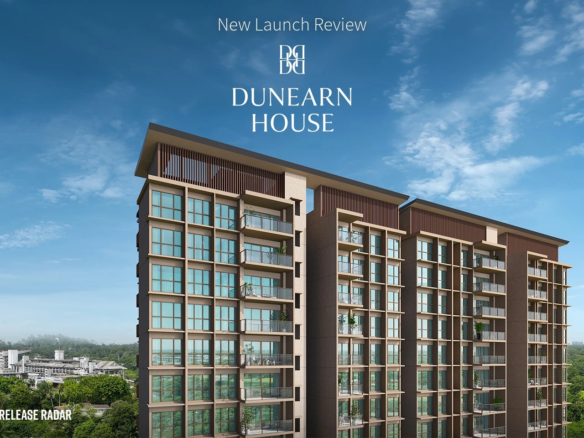
This trend will apply directly to 2026’s launches, such as River Modern, Newport Residences, Dunearn House and Amberwood at Holland.
RCR is tight in 2026, but not empty
RCR appears lean for 2026, but the picture is more nuanced. District 5 still has remaining stock in Terra Hill, Blossoms by the Park, The Hillshore, ELTA and LyndenWoods, plus investor stock in One-North rentals.
This affects how buyers will view Hudson Place Residences — a strong location for tenants, but entering a competitive micro-market.
Meanwhile, Thomson Reserve benefits from the opposite dynamic: central-fringe scarcity, school-belt appeal and proximity to nature and MRT. Families planning ahead for primary school access, such as Ai Tong Primary School, will be evaluating condo options in this area.
Rates and real incomes improved affordability
Interest rates have retreated meaningfully from their 2023 highs, improving monthly instalments and stress-test buffers. At the same time, MAS reported real income growth recovering to 4.3% in 2025 amid low inflation.
This combination brought many buyers who had paused for 1–2 years back into the market, particularly families comparing resale vs new launch affordability.
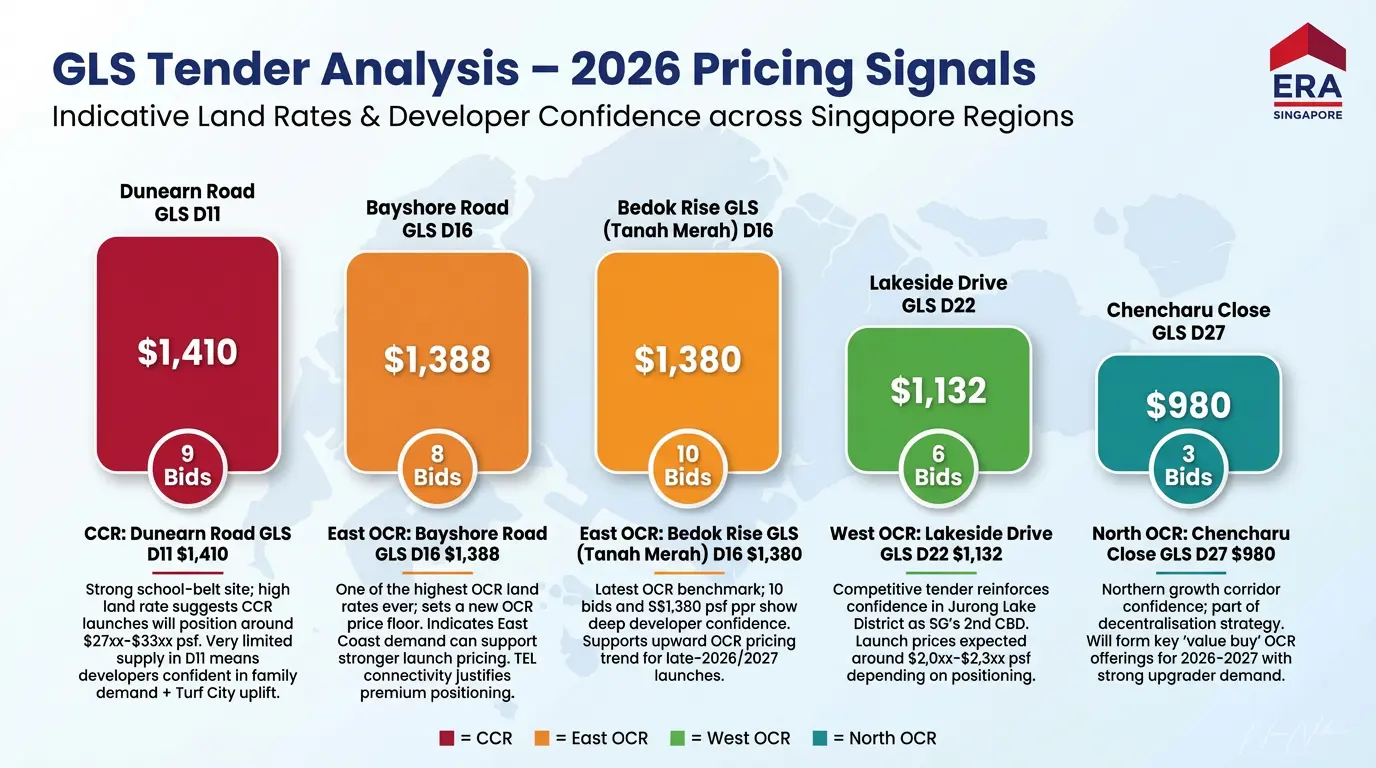
GLS tenders show high developer conviction
Recent GLS results reveal developer sentiment clearly:
- Dunearn House — $1,410 psf ppr (9 bids)
- Vela Bay — $1,388 psf ppr (8 bids)
- Lucerne Grand — $1,132 psf ppr (6 bids)
- Chencharu Close GLS — $980 psf ppr (3 bids)
- Bedok Rise GLS — $1,330 psf ppr (10 bids)
The 10 bids for Bedok Rise were especially noteworthy — a clear signal that developers are bullish about OCR upgrader demand heading into 2026.
Unsold Inventory Snapshot (as of Q4 2025)
Unsold inventory influences how aggressively developers price new launches, how quickly they adjust prices after launch, and how sensitive each region is to external shocks. The picture entering 2026 is clear:
| Region | Representative Projects | Approx. Unsold Units | What It Suggests |
|---|---|---|---|
| CCR |
Upper House, Skye at Holland, River Green, W Residences, One Sophia, Robertson Opus, Aurea |
~250 units | CCR stock remains available but moves more steadily. Buyers choose carefully, often committing closer to TOP. CCR launches work best as lifestyle or long-cycle holdings. |
| RCR |
Terra Hill, Blossoms by the Park, The Hillshore, ELTA, LyndenWoods, Grand Dunman |
~220 units | RCR remains tight, but District 5 still has stock. Media Circle must navigate this competitive backdrop; Thomson Reserve benefits from strong central-fringe scarcity. |
| OCR | Various mature-area OCR launches (2022–2024) | ~80 units island-wide | OCR is nearly cleared, giving 2026’s many upgrader-focused launches a clean runway. |
Why 2026 Is a Pivotal Year
The 2026 new launch pipeline is not just large — it is strategically important. Supply is uneven, buyer confidence is improving, income growth has strengthened, and several transformation zones are entering visible execution. These factors set the foundation for a year that could shape Singapore’s property landscape for the next decade.
Supply is large but uneven
The 24 planned launches (11,818 units) are spread across OCR, RCR and CCR — but not evenly:
- OCR (≈ 71%) — the main engine of demand, driven by HDB upgraders.
- RCR (≈ 18%) — limited supply, but still some competition in D5.
- CCR (≈ 11%) — selective launches with long-cycle demand.
For readers newer to the private-property landscape, CCR, RCR and OCR each play a different role in shaping demand. OCR remains the most active because of upgrader-driven demand, while RCR and CCR behave more selectively depending on location, tenure and price sensitivity.
Affordability and real incomes improved
Affordability in 2026 is stronger than it was in 2023–2024. Two major shifts occurred:
- Interest rates fell from their peak, reducing monthly instalments.
- Real income growth recovered to about 4.3% as inflation eased.
This means buyers entering 2026 — especially upgraders — are operating with better overall financial confidence, even if prices remain high.
Transformation zones are entering a visible phase
2026 is the first year where several long-discussed transformation areas begin taking visible shape. These zones are critical because they influence long-term price growth and buyer demand.
Tengah — Singapore’s first forest town expands into private market
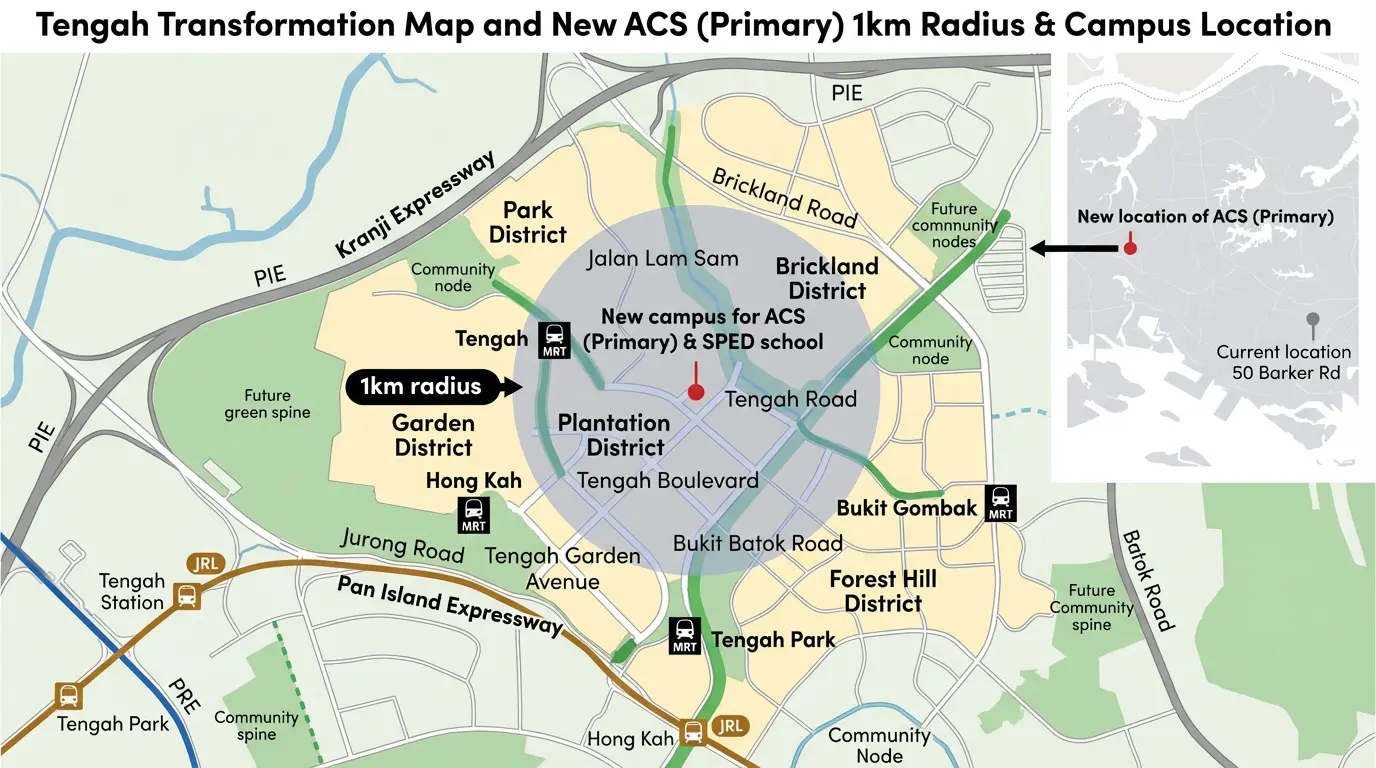
Tengah has been developing steadily over the last few years, but 2026 marks the first major step into private housing with the launch of Tengah Garden Residences. This launch sits at the heart of a transformation powered by:
- the upcoming Jurong Region Line (JRL)
- new MRT nodes such as Hong Kah and Tengah Plantation
- a car-lite, sustainability-focused master plan
- close proximity to Jurong Lake District
- ACS (Primary) relocating to Tengah in 2030
This last point is extremely significant. Historically, the presence of top primary schools has shaped price growth in Bukit Timah, Queenstown and Marine Parade. Tengah could follow a similar trajectory, as families plan ahead for the ACS relocation.
Bukit Timah / Dunearn Road / Turf City — a once-in-a-generation redevelopment
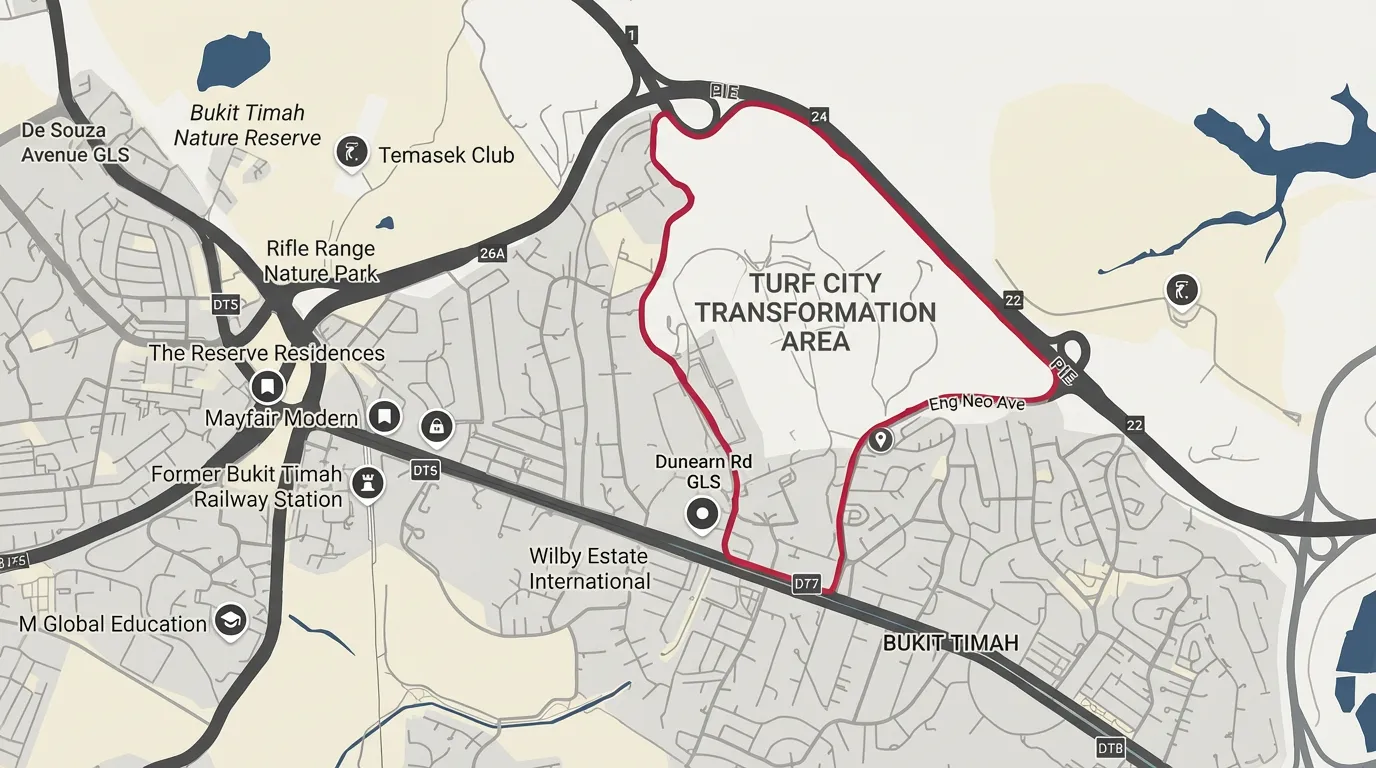
The Turf City transformation is one of Singapore’s most significant redevelopment stories. It will reshape the surrounding Bukit Timah–Dunearn Road corridor — an area already known for its prestigious schools and low-density living.
Located in this zone, Dunearn House is positioned to benefit from:
- school-belt demand (SCGS, ACS, Nanyang Primary nearby)
- limited new supply in Bukit Timah over the last decade
- the uplift from Turf City’s redevelopment
The Bukit Timah belt consistently attracts families prioritising proximity to well-known schools. As highlighted in the Ai Tong School and Bright Hill MRT condo guide, parents planning for primary school access often make decisions years ahead. Dunearn House is well positioned to benefit from similar long-term planning behaviour.
Bayshore — the East Coast’s new integrated waterfront node
Bayshore is evolving into a fully integrated waterfront district. With two TEL stations — Bayshore and Bedok South — and a master plan connecting homes directly to East Coast Park, this zone is expected to anchor the next phase of East-side OCR demand.
The Vela Bay carries one of the highest OCR land costs ever tendered at around $1,388 psf ppr. High land cost introduces price sensitivity, but it also signals developer conviction in the long-term East Coast story.
Much like how the Lentor cluster formed a new identity in 2022–2024, Bayshore could become the defining OCR cluster of the next decade.
Developers are confident — but selective
Unlike 2017–2018, when developers aggressively accumulated en bloc sites, 2024–2025 developers bid selectively. Strong bids concentrated in specific zones:
- Dunearn House — school belt + transformation uplift
- Vela Bay — East Coast waterfront district
- Lucerne Grand — JLD adjacency
- Lentor Gardens Residences — continued cluster identity
- Chuan Grove GLS — mature D19 upgrader base
The message is clear: developers are bullish, but only in locations with long-term planning support, transformation uplift or proven school-belt demand.
2026 Pipeline Overview by Region
The 2026 pipeline features 24 launches and 11,818 units, but the distribution across OCR, RCR and CCR matters far more than the total number. Each region has a different demand base, different supply story and different long-term outlook. Understanding these differences helps buyers avoid overpaying in the wrong micro-market — and spot scarcity opportunities early.
Below is a detailed breakdown of how each region will shape buyer behaviour in 2026.
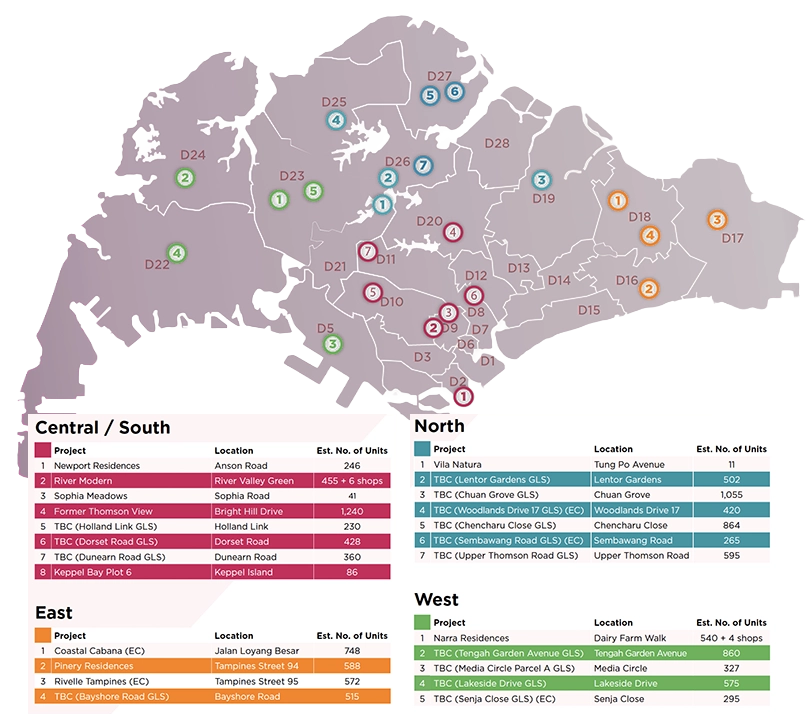
OCR — The Core Engine of 2026
OCR will define the overall sentiment of the 2026 new launch market. With nearly three-quarters of all new units, OCR launches will determine pricing benchmarks, quantum expectations and early-year momentum.
Key OCR launches include:
- Tengah Garden Residences — the first private condo in Tengah, next to future Hong Kah MRT, and the earliest beneficiary of ACS (Primary)’s 2030 relocation.
- Vela Bay — a high-stakes, high-land-cost East Coast node anchored by TEL connectivity and waterfront access.
- Pinery Residences — riding on Tampines’ huge upgrader base, strong transport links and decades of proven resale demand.
- Chuan Grove GLS — located in a mature D19 belt supported by family demand and established amenities.
- Lentor Gardens Residences — the next phase of the Lentor masterplan, building on the established Lentor identity formed between 2022–2024.
- Coastal Cabana EC — a rare seafront executive condo in Pasir Ris, previewing 6–21 December 2025 and booking on 17 January 2026.
What this means for buyers: OCR price growth will likely continue into 2026, but more evenly. MRT adjacency, transformation uplift and quantum discipline will separate the winners from the merely “okay” launches.
RCR — Selective but High-Impact
RCR supply is thin for 2026, but the two major launches carry enormous significance because they target different buyer profiles entirely.
- Thomson Reserve — the central-fringe RCR heavyweight. Near-CCR in appeal, with Upper Thomson MRT, nature corridor frontage and a highly strategic position for Ai Tong families.
- Hudson Place Residences — the one-north investor magnet with immediate access to Fusionopolis, Biopolis and tech-sector tenant pools.
But… RCR is not empty. District 5 still holds unsold stock from:
This means Hudson Place Residences must compete intelligently — especially for investor dollars — while Thomson Reserve faces virtually no central-fringe competition.
CCR — Premium, Selective and Long-Cycle
CCR has the smallest 2026 pipeline, but arguably the highest strategic value. This year’s launches are not “mass-market CCR” — they are targeted, differentiated and designed for affluent buyers with longer horizons.
- River Modern — integrated with Great World MRT, river frontage, mall access and a historically strong rental base.
- Newport Residences — a rare freehold CBD-fringe launch with high rentability and limited competition in its micro-market.
- Dunearn House — benefiting from Bukit Timah’s school belt and the powerful uplift of the Turf City redevelopment.
- Amberwood at Holland — a niche D10 launch in a low-density lifestyle enclave.
- Keppel Bay Plot 6 — the evolution of waterfront CCR-fringe living with strong tenant appeal.
The CCR buyer of 2026 is not rushed. They prioritise tenure, location and long-term capital preservation. CCR projects tend to move in longer, steadier buying cycles, with demand building gradually rather than concentrating on launch weekend.
Original Price Expectations for 2026
Original forecast: The following bands were published in late 2025, before most projects released final price lists. They are retained as a record of the outlook rather than presented as live pricing guidance:
- OCR (Private): $2,000 – $2,400 psf
- Premium OCR: $2,700 – $3,000 psf (with Vela Bay as the clearest example in the original forecast)
- Executive Condos: from ~$1,639 psf
(e.g., Coastal Cabana EC) - RCR: $2,300 – $2,600 psf
- CCR: $2,700 – $3,800 psf
(higher for freehold and premium stacks such as Newport Residences)
These price levels reflect today’s market fundamentals — including higher GLS land rates, construction costs and the exceptionally low supply of OCR units entering 2026. Developers are operating within a tighter cost structure, which sets firmer price floors across most segments.
Top 10 New Launch Projects to Watch in 2026
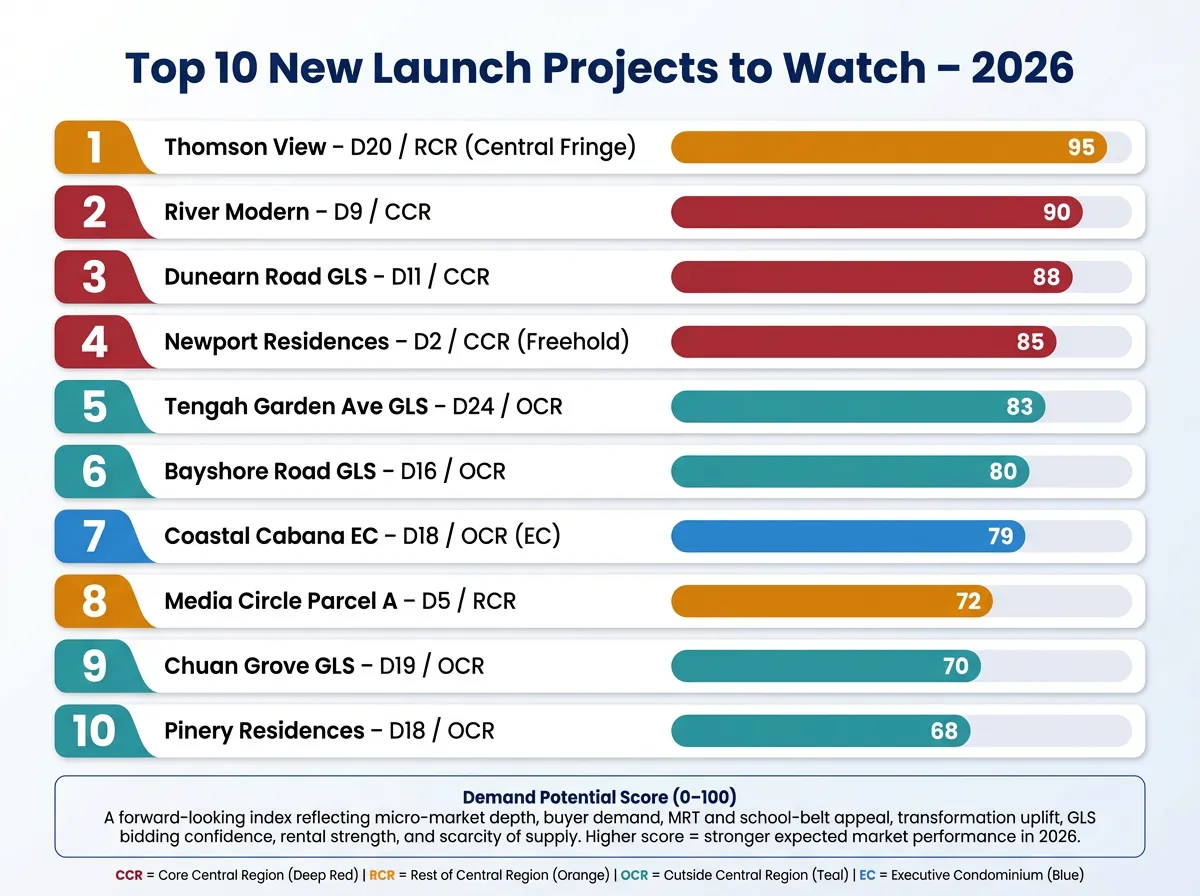
Original late-2025 forecast: This ranking is intentionally preserved so it can be assessed with hindsight. Project names and links have been updated, but the order has not been retrofitted after launch results became known.
- Thomson Reserve – RCR (Central Fringe)
- River Modern – D9 / CCR
- Dunearn House – D11 / CCR
- Newport Residences – D2 / CCR (Freehold)
- Tengah Garden Residences – D24 / OCR
- Vela Bay – D16 / OCR
- Coastal Cabana EC – D18 / OCR (EC)
- Hudson Place Residences – D5 / RCR
- Chuan Grove GLS – D19 / OCR
- Pinery Residences – D18 / OCR
Why Thomson Reserve ranks #1: It combines multiple long-term demand pillars rarely found in a single project — central-fringe location, strong school-belt appeal, MRT access, nature proximity and genuine scarcity of new supply in the area. Its scale and positioning place it at the centre of upgrader demand for 2026.
Where We Are in the Property Cycle
To understand where 2026 sits in Singapore’s property cycle, it helps to look at demand behaviour in 2025, GLS bidding trends and broader economic data. Multiple indicators now point to an early expansion phase — a period where confidence improves gradually, price growth stabilises, and buyers become more decisive.
The property market cycles guide outlines how Singapore’s real estate market typically moves through phases of hesitation, recovery, expansion and consolidation. Based on current demand, affordability and GLS behaviour, 2026 aligns most closely with the early expansion phase.
Key supporting signals:
- Interest rates have eased from their peak, bringing down monthly instalments and stress-test burdens.
- Real income growth improved to 4.3% in 2025, giving households stronger purchasing power.
- OCR stock is at one of the lowest points in the past decade, creating natural upward pressure for well-located projects.
- GLS tenders are competitive — with multiple sites receiving 6–10 bids, signalling developer confidence.
- Transformation zones (Tengah, Bayshore, Turf City, Lentor) are crossing into visible execution phases.
This does not imply a runaway bull market. Instead, 2026 is likely to deliver targeted strength: projects with strong fundamentals will perform well, while weaker projects may struggle against better alternatives.
Key Risks and Unknowns
Even in a constructive environment, it is important to recognise risks that may shape buying behaviour and launch performance throughout the year.
Global macro and geopolitical shocks
A sharp recession, geopolitical escalation or financial sector stress could temporarily dampen sentiment, especially for higher-psf CCR launches.
Overpricing in select OCR sites
High land costs at certain GLS plots mean developers will push pricing boundaries. If those prices exceed upgrader comfort levels, demand may slow despite good fundamentals.
Policy changes
If prices rise too rapidly, targeted cooling measures are possible — particularly toward investment-heavy districts.
CCR’s longer absorption cycle
CCR launches typically sell steadily but slowly. Projects such as W Residences and Robertson Opus show how momentum increases closer to TOP, rather than during launch weekend.
Localized competition
Districts with overlapping supply — such as D5 — require sharper differentiation in layout, price and positioning. Meanwhile, central-fringe locations like Thomson Reserve benefit from scarcity.
How a Personal Strategy Matters More Than the Market
Market-wide outlooks are useful for understanding big-picture trends, but real estate decisions are always personal. Your financial profile, timeline, family needs and long-term plans matter far more than whether “the market is hot” or “prices are rising.”
Key strategic considerations include:
- your loan profile, interest-rate sensitivity and long-term holding power
- whether you intend to prioritise schools (e.g., Ai Tong, ACS, SCGS)
- whether lifestyle or convenience matters for daily routine
- your tolerance for renovation, rental management or vacancy risk
- whether rental yield, capital appreciation or both are important
The property cycles guide shows that buyers who align their decisions with their financial horizon and holding power often achieve better long-term outcomes than those trying to time short-term price movements.
In 2026, the central strategic question isn’t “Is this the right time?”
It’s: “Which move positions my family or portfolio best over the next 5–10 years?”
Frequently asked questions
Is 2026 a good time to buy?
For many genuine buyers, 2026 can still offer suitable opportunities—especially for HDB upgraders and buyers considering transformation areas. The better question is whether a particular project, price and holding period fit your own finances and plans.
Should I focus on OCR, RCR or CCR?
OCR generally has the deepest upgrader demand, RCR offers selective city-fringe opportunities, and CCR suits buyers prioritising centrality, prestige or longer holding periods. Region alone is not enough: entry price, layout, nearby supply and the likely resale audience still matter.
Are executive condominiums worth considering?
ECs can offer strong value for eligible owner-occupiers because their initial pricing is usually below comparable private condominiums. However, the eligibility rules, Minimum Occupation Period and longer pathway to full privatisation mean they will not suit every buyer or timeline.
Will Singapore condo prices fall?
A broad decline is not the only outcome buyers should plan for. High land and construction costs provide some price support, but individual projects can still underperform when launch pricing is stretched or competing supply is stronger. Project selection and holding power matter more than a single market forecast.
How important is ACS (Primary)’s move to Tengah?
The 2030 relocation could strengthen long-term family interest around Tengah, particularly within the relevant school-distance bands. Buyers should nevertheless avoid treating a future school move as a guaranteed price catalyst and should verify the final address and distance through official channels.

Planning a property move in 2026?
I can help you compare the launches in this outlook with suitable resale alternatives, assess affordability and narrow the choice to projects and units that genuinely fit your family, timeline and holding power.