Last Updated on September 25, 2026
Buying a resale condo is not only about whether the numbers work overall. It is a cash-flow exercise: option money, the exercise deposit and stamp duties can fall due before your bank loan and Central Provident Fund (CPF) savings are released at completion.
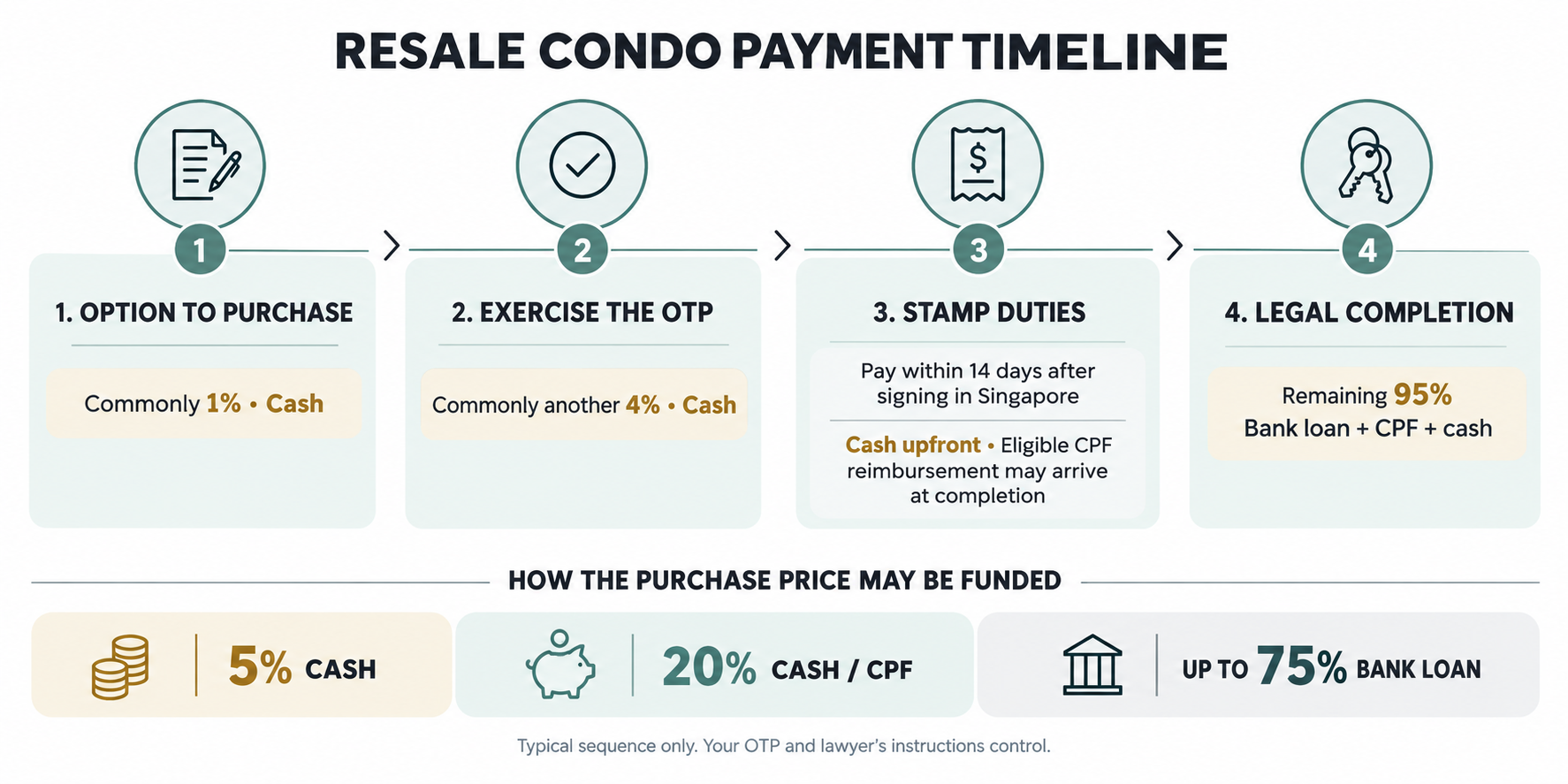
This guide maps the usual Singapore private resale timeline from Option to Purchase (OTP) to key collection. It separates the transaction schedule—commonly 1% + 4% + 95%—from the funding structure, such as 5% cash + 20% cash or CPF + 75% bank financing.
Key takeaways
- The signed OTP controls the deposit, exercise deadline, completion date and payment instructions.
- A common sequence is 1% option money, another 4% on exercise and the remaining 95% at completion.
- Buyer’s Stamp Duty (BSD) and any Additional Buyer’s Stamp Duty (ABSD) are separate from the purchase price and generally have an earlier deadline.
- CPF may ultimately fund eligible amounts, but buyers can still need cash first—especially for stamp duties.
- Final loan approval, valuation and the timing of sale proceeds can change the cash required.
The four payment stages
| Stage | Usual timing | Typical payment |
|---|---|---|
| OTP issued | Day 1 | Commonly 1% cash |
| OTP exercised | Often within 2 weeks | Commonly another 4% cash |
| Stamping | Generally within 14 days | BSD and any ABSD |
| Completion | Date stated in the OTP | Remaining 95%, less adjustments |
Quick navigation
Acronym glossary
Before the OTP: prepare the cash calendar
An in-principle approval (IPA) is not final loan approval. Confirm the lender’s valuation, credit conditions, Total Debt Servicing Ratio (TDSR) position, loan tenure and final loan-to-value (LTV) limit. A lower valuation can create a larger cash or CPF shortfall even if you expected 75% financing.
- Check the cash available for the initial 5%, stamp duties and fees.
- Estimate eligible CPF Ordinary Account (OA) savings and housing usage limits.
- Confirm whether proceeds from another property will arrive before completion.
- Check whether the property is sold with vacant possession or subject to tenancy.
- Record the exercise and completion dates stated in the OTP.
See MoneySense’s affordability guide. For a different transaction structure, compare my new-launch payment timeline.
Stage 1: Pay the option money—commonly 1%
In a typical private resale transaction, the buyer pays 1% of the agreed price when the seller grants the OTP. This is market practice, not a statutory percentage, so the signed document may state a different amount.
The option period is also contractual. The CEA template lets the parties specify the deadline; two weeks is common, but your OTP may differ. Missing the deadline or exercising incorrectly can cause the option to lapse and the option money to be forfeited.
Stage 2: Exercise the OTP—commonly another 4%
To exercise, the buyer signs and delivers the acceptance copy in the required way and pays the exercise sum. Commonly, a further 4% brings the total deposit to 5%.
The OTP must identify the recipient. Depending on the transaction, payment may go to the seller, a law firm’s designated conveyancing account or the Singapore Academy of Law as stakeholder. Estate agents must not hold transaction money. The Ministry of Law explains the safeguards for conveyancing money.
Stage 3: Pay BSD and any ABSD on time
For a typical resale purchase, the exercised OTP is the dutiable instrument. IRAS says documents signed in Singapore must generally be stamped within 14 days. Documents signed overseas must generally be stamped within 30 days after receipt in Singapore.
| Residential value band | BSD rate |
|---|---|
| First S$180,000 | 1% |
| Next S$180,000 | 2% |
| Next S$640,000 | 3% |
| Next S$500,000 | 4% |
| Next S$1.5 million | 5% |
| Amount above S$3 million | 6% |
BSD is calculated on the higher of the price or market value. ABSD depends on the buyers’ residency, property count and ownership structure. Before exercising, verify the latest BSD rates and ABSD rules with IRAS.
Stage 4: Legal completion and key collection
Completion is often negotiated around 8 to 12 weeks after exercise, but the OTP controls. Your lawyer coordinates title checks, the caveat, CPF applications, bank drawdown conditions and the completion account. The remaining price is paid using the bank loan, eligible CPF savings and any cash balance.
The Council for Estate Agencies’ private residential property guidance includes a buyer checklist and OTP template. Customary figures never override the signed contract.

Planning a resale condo purchase?
I can help you map the OTP, cash, CPF and bank-loan dates before you commit, including how another property sale affects the sequence.
The CPF timing issue buyers often miss
CPF OA savings may be used for eligible purchase amounts, stamp duties and legal fees, subject to CPF rules and available balances. For a completed property, however, stamp duty generally has to be paid in cash first.
Read the CPF Board’s guidance on property-related fees and use its housing usage calculator for an estimate.
Worked example: S$2 million resale condo
Assume a Singapore citizen buying a first residential property, no ABSD, no outstanding housing loan, a 75% approved bank loan, a valuation at least equal to the price and sufficient eligible CPF savings.
| Payment | Illustrative amount |
|---|---|
| 1% option money | S$20,000 cash |
| Further 4% on exercise | S$80,000 cash |
| Remaining 95% at completion | S$1.9 million |
| Illustrative BSD | S$69,600 |
| Cash required before legal fees in this illustration | At least S$169,600 |
The completion balance may combine a S$1.5 million loan with S$400,000 of eligible CPF and/or cash equity. BSD and legal or valuation fees sit outside the S$2 million price.
Five risks that can change the plan
Checklist before paying the option money
- Obtain an IPA and understand the conditions still outstanding.
- Confirm the bank’s valuation basis and your expected LTV.
- Check your available cash and CPF separately.
- Estimate BSD and any ABSD using current IRAS rules.
- Align sale proceeds, CPF refunds and purchase completion dates.
- Ask your lawyer to confirm the recipient and payment instructions.
- Keep a buffer for legal fees, valuation, moving and renovation.
Stress-test the numbers before committing
A workable purchase plan is built around verified funding dates, not only headline percentages. I can help you compare the sequence against your CPF, financing and sale arrangements.
Frequently asked questions
Can CPF pay the 1% option fee or 4% exercise fee?
Buyers of completed resale properties should normally be prepared to pay the initial 5% in cash. CPF money is released through the legal completion process.
Is the completion balance always 95%?
It is commonly 95% after a 5% deposit, but the final amount reflects the actual deposit and completion-account adjustments. Your lawyer’s completion statement is authoritative.
When does the stamp-duty deadline start?
Generally from execution of the dutiable purchase instrument. In a typical resale transaction, this is the acceptance or exercise of the OTP.
Can ABSD wait until I sell my existing home?
Do not plan on a deferment. If ABSD applies, it is an upfront cost even if you may later qualify to apply for a remission or refund.
Does the buyer pay an agent commission?
It depends on the agreed agency arrangement. Commission is negotiable and separate from duties and legal fees. See my agent commission guide.
This article is general information, not legal, tax or financial advice. Rules and rates can change; verify current requirements with IRAS, CPF Board, your bank and your conveyancing lawyer.