Last Updated on September 28, 2026
Updated for the August 2026 EC income ceiling changes.
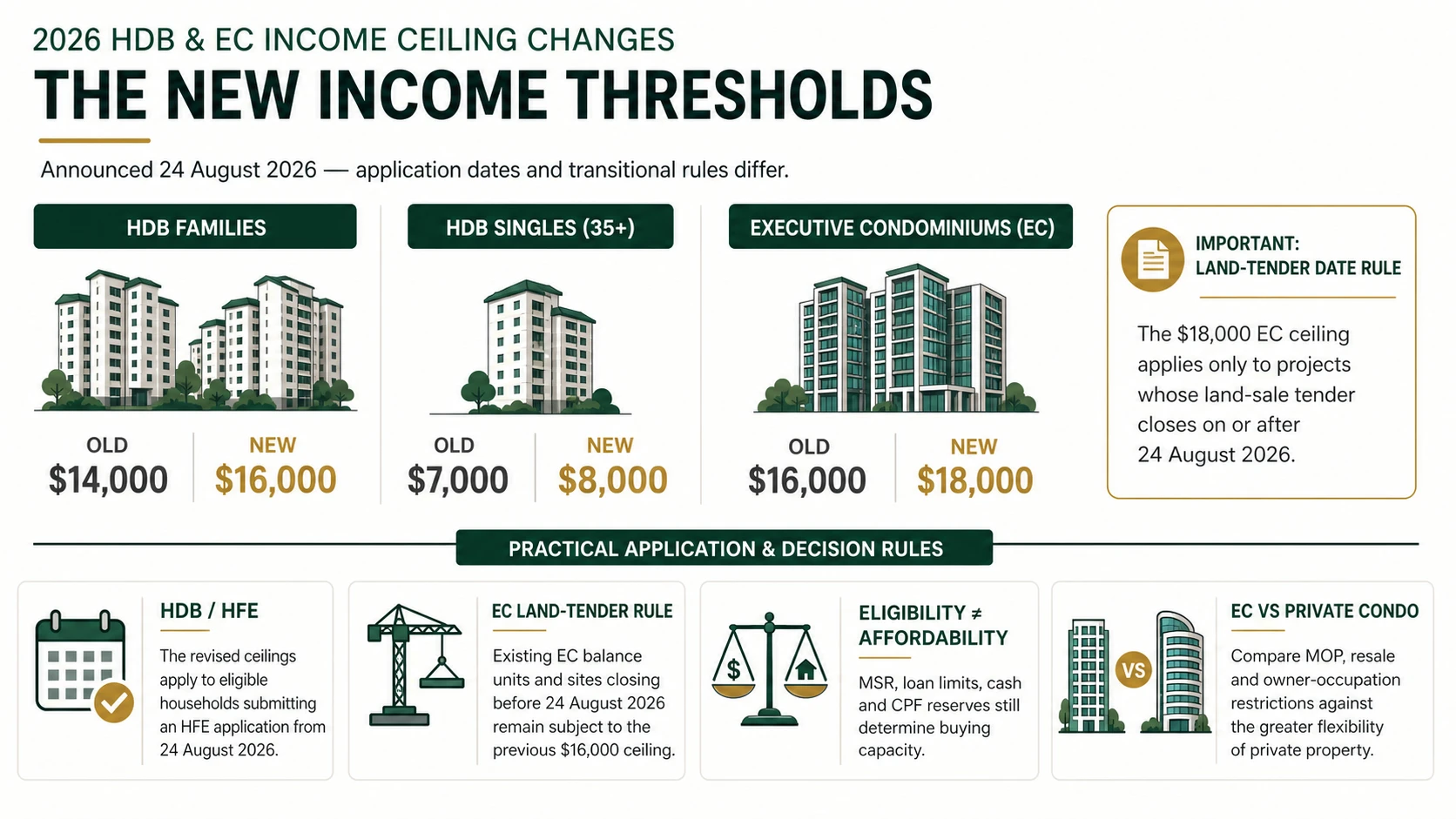
In its August 2026 housing announcement, HDB confirmed that the monthly household income ceiling for subsidised HDB housing would rise from $14,000 to $16,000. The EC income ceiling for selected future Executive Condominium projects has also increased from $16,000 to $18,000.
That sounds like a straightforward expansion of choice. In practice, it creates a more complicated question for households near the new limits: now that you may qualify, should you actually buy a BTO flat or an EC—or would a private condominium still give you the better fit?
Eligibility opens a door. It does not tell you which door to walk through. The answer depends on the particular EC, your cash and CPF position, how long you can accept being locked in, and whether your family needs flexibility more than a subsidised entry price.
Key takeaways
- The $16,000 HDB ceiling applies to eligible families applying for an HFE letter from 24 August 2026.
- The $18,000 EC ceiling does not apply to every EC currently on sale. It applies to new units on sites whose land-sale tender closes on or after 24 August 2026.
- Existing EC balance units and earlier-awarded sites remain subject to the previous $16,000 ceiling.
- Newer EC sites may also carry a 10-year MOP, depending on when their land tender closed.
- A higher income ceiling improves eligibility, but the Mortgage Servicing Ratio, available cash and CPF, resale restrictions and household plans still determine affordability and suitability.
- For households earning between $16,000 and $18,000, the useful comparison is usually a future eligible EC versus a suitable private condo—not EC versus private condo in the abstract.
What changed in August 2026?
From 24 August 2026, eligible families applying for an HDB Flat Eligibility letter are assessed against a monthly household income ceiling of $16,000, up from $14,000, for three purposes:
- buying a new subsidised flat from HDB;
- buying a resale HDB flat with a CPF Housing Grant; and
- obtaining an HDB housing loan for a new or resale flat.
For eligible singles aged 35 and above, the corresponding ceiling increased from $7,000 to $8,000.
The income ceiling for buying a new EC from a developer also increased from $16,000 to $18,000—but its implementation is tied to the project’s land-tender date, not simply the date on which a buyer submits an application.
The important catch: the $18,000 EC ceiling is not universal
This is the part most likely to be missed in a headline.
The revised $18,000 ceiling applies to new units in EC projects whose land-sale tender closes on or after 24 August 2026. According to HDB, it does not apply to balance units in existing ECs or to projects awarded before that date.
In other words, a couple earning $17,000 a month cannot look at every EC currently marketed and assume that it has become eligible overnight. The applicable ceiling must be checked project by project.
There is a second date to understand. EC projects whose land tender closed on or after 8 May 2026 are subject to a 10-year MOP from TOP. These units may be sold to Singapore Citizens or Permanent Residents after the MOP, while access for foreigners and corporate bodies comes only after 15 years from TOP.
This longer runway changes the comparison with a private condo. Buyers are not merely accepting a lower entry price in exchange for some paperwork. They are accepting a materially longer period in which changing family, career or housing plans may be harder to accommodate.
| Housing route | Previous ceiling | Revised ceiling | Key implementation point |
|---|---|---|---|
| New subsidised HDB flat | $14,000 family | $16,000 family | For eligible households applying for an HFE letter from 24 August 2026 |
| Resale HDB with CPF Housing Grant | $14,000 family | $16,000 family | The income ceiling relates to grant eligibility, not the basic ability to buy an ordinary resale flat |
| HDB housing loan | $14,000 family | $16,000 family | Applies through the HFE assessment |
| New EC from developer | $16,000 | $18,000 for qualifying future sites | Only where the EC land-sale tender closes on or after 24 August 2026 |
Who is newly eligible—and what has not changed?
The obvious beneficiaries are families whose assessed monthly household income falls above the old limit but within the new one. However, the higher ceiling does not remove the other conditions attached to HDB flats or new ECs.
For a new EC, applicants still need to satisfy the prevailing citizenship, family-nucleus and property-ownership rules. Applicants and occupiers cannot own an interest in local or overseas private residential property and generally must not have disposed of one within the preceding 30 months.
Nor does an $18,000 income automatically create a large housing loan. New EC financing remains constrained by the applicable borrowing framework, including the Mortgage Servicing Ratio. Your existing debts, ages, loan tenure, cash and CPF balances, and the bank’s assessment all matter. My guide to TDSR, MSR and property financing explains why the headline income number is only one part of the calculation.

Newly inside the EC ceiling?
Before focusing on a showflat, I can help you check which future ECs actually use the revised ceiling and compare the likely cash flow against suitable private-condo alternatives.
EC or private condo: what changes at $16,000–$18,000?
For this income band, a new EC may offer access to a larger family home or newer facilities at a lower entry price than a comparable new private condo. But the strongest financial-looking option on paper may not be the best household decision.
| Decision factor | Qualifying future new EC | Private condo |
|---|---|---|
| Eligibility | Income ceiling, citizenship, family-nucleus and property rules apply | No household income ceiling or HDB family-nucleus test |
| Choice of project | Limited to the EC supply and locations released | Much wider new-launch and resale selection |
| Financing | Bank loan; MSR and TDSR considerations apply | Bank loan; TDSR applies, without the EC income ceiling |
| Occupation and sale | Owner-occupation and MOP restrictions apply; newer sites may carry a 10-year MOP | No HDB MOP, although Seller’s Stamp Duty and other ownership costs still matter |
| Immediate rental | Not a route for a buyer seeking immediate whole-unit investment flexibility | Can suit an investment or immediate-rental plan, subject to the property and regulations |
| Exit flexibility | Narrower during the restricted years | Broader buyer pool and earlier flexibility, subject to market conditions and taxes |
| Potential advantage | More accessible entry into private-style living if the specific project is well priced | Freedom of location, property type, timing and use |
An EC may make more sense when:
- you genuinely expect to occupy the home for the full restricted period;
- the project’s location and layouts suit the family, rather than merely being the EC available at the time;
- the price gap against credible private and resale alternatives is meaningful;
- you can fund the purchase comfortably under the borrowing limits without exhausting reserves; and
- your career, family size and schooling plans are unlikely to require an earlier move.
A private condo may still make more sense when:
- you need a specific location that the EC pipeline does not serve;
- you want the option to rent, sell or restructure earlier;
- you are buying alone or do not meet the EC family-nucleus rules;
- you already own, or recently disposed of, private property;
- a suitable resale condo offers better space or location at a comparable total cost; or
- the EC’s price premium over nearby resale alternatives is too aggressive.
Eligibility is not the same as affordability
The income ceiling answers whether HDB allows you to apply. It does not answer whether a bank will lend the amount you expect, whether the downpayment is comfortable, or whether the monthly commitment leaves enough room for children, retirement and unexpected costs.
A household earning $18,000 may have less usable borrowing capacity than another household on the same income because of car loans, ages, variable income or a shorter available loan tenure. It may also have very different CPF and sale proceeds.
This is why I would not choose between an EC and private condo from a price-per-square-foot comparison alone. Start with:
- cash and CPF available after retaining an emergency buffer;
- the loan amount assessed under the correct EC or private-property framework;
- monthly repayments at a prudent interest-rate assumption;
- renovation, maintenance and transitional housing costs;
- the minimum period the family can realistically remain in the property; and
- the resale audience and competing supply when you may eventually exit.
If you are still establishing the upper end of your budget, see my guide on how salary translates into condo affordability. If you are selling an HDB flat to move, the broader sequence matters just as much; my property-upgrading framework covers that planning process.
A practical decision framework
My view: the higher ceiling helps, but it does not settle the decision
The increase to $18,000 is meaningful because it restores access for households whose incomes have moved beyond the old EC threshold. It may give more families a path to a larger owner-occupied home with condominium facilities.
However, the benefit will arrive through future qualifying EC sites, not automatically through every project already available. Some of those future projects will also require a much longer commitment under the new MOP rules.
For a household between $16,000 and $18,000, I would treat the change as permission to compare—not a signal to buy. If a qualifying EC offers the right location, efficient layout and a defensible price gap, it can be compelling. If it requires compromising on location or locking the family into an uncertain plan, a well-chosen private or resale option may be worth the premium.
Compare the options before committing
I can help you model a qualifying EC against private and resale alternatives using your actual timeline, CPF position, expected sale proceeds and family priorities.
Frequently asked questions
What is the new HDB income ceiling in 2026?
For eligible families applying for an HFE letter from 24 August 2026, the monthly household income ceiling is $16,000 for buying a new subsidised flat, buying a resale flat with CPF Housing Grant, or obtaining an HDB housing loan. The corresponding ceiling for eligible singles aged 35 and above is $8,000.
Is the EC income ceiling now $18,000 for every project?
No. The $18,000 ceiling applies to new units in EC projects whose land-sale tender closes on or after 24 August 2026. It does not apply to balance units in existing ECs or earlier-awarded sites. Always verify the rule for the specific project.
Does an income below $18,000 mean I can definitely buy a new EC?
No. You must also satisfy the citizenship, family-nucleus, property-ownership and other HDB EC eligibility conditions. Your financing must separately be approved by a bank.
Will a higher income let me borrow more for an EC?
Potentially, but not without limit. The bank will assess your income, debts, ages and loan tenure under the applicable MSR, TDSR and loan-to-value rules. The income ceiling is an eligibility cap, not a promised loan amount.
Do all new ECs still have a five-year MOP?
No. HDB states that EC projects whose land-sale tender closed on or after 8 May 2026 have a 10-year MOP calculated from TOP. Check the applicable rules for the project you are considering.
Should a household earning $16,000–$18,000 choose an EC or private condo?
There is no universal answer. An EC can offer an attractive entry price for a long-term owner-occupier, while a private condo offers wider choice and greater flexibility. Compare actual units, financing, location and your likely holding period before deciding.
Policy note: Housing and financing rules can change, and individual eligibility depends on HDB and lender assessment. Verify the latest requirements before making a purchase decision.