Last Updated on November 5, 2025
A Market Moving Against the Tide
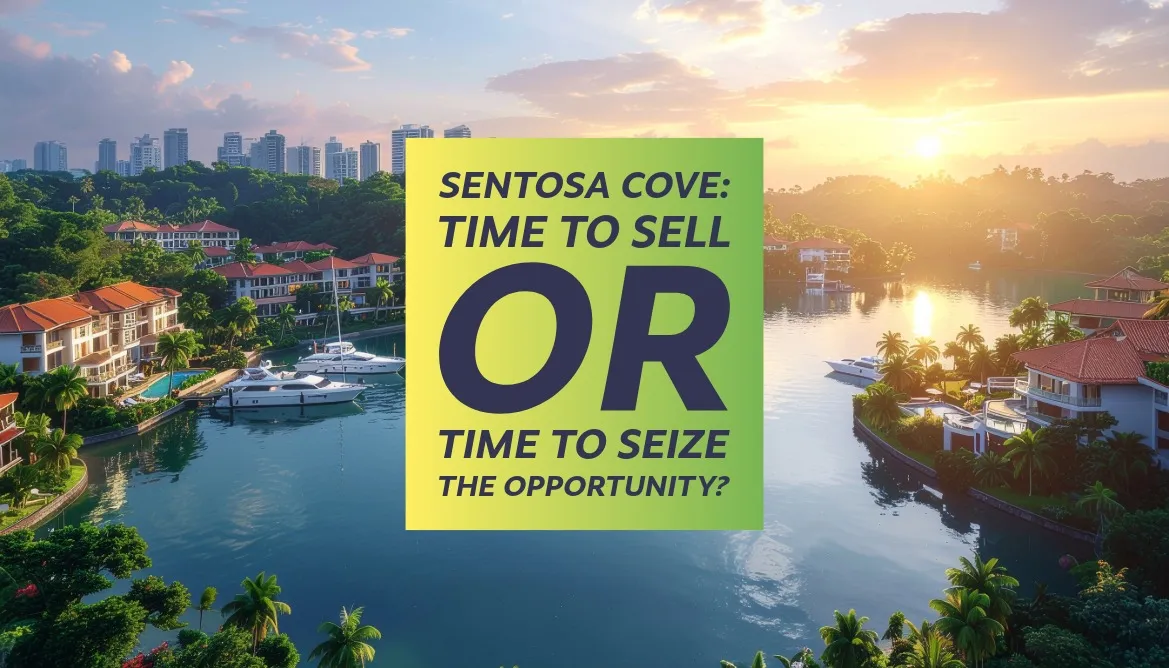
While mainland Singapore continued to post price gains through 2024 and into late 2025, Sentosa Cove went the opposite way. According to URA data reported by The Straits Times, two-thirds of resale homes on the island changed hands at a loss, marking one of its weakest years since the 2010s.
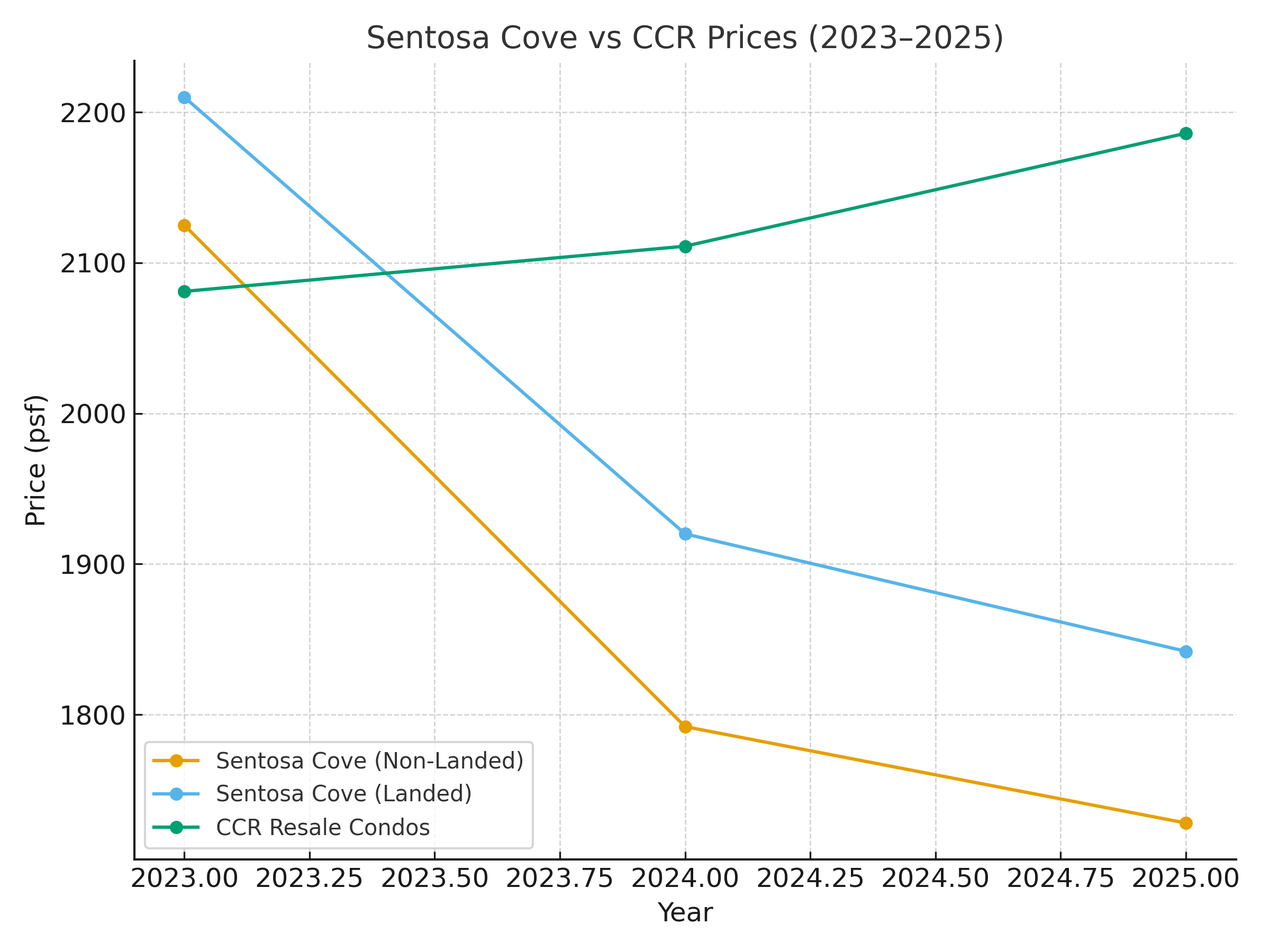
Prices for non-landed homes fell about 18.7%, from $2,125 psf in 2023 to $1,728 psf this year. Landed prices dropped roughly 13%, from $2,210 psf to $1,842 psf. By contrast, resale condominiums in the Core Central Region (CCR) climbed to $2,186 psf, underscoring how Sentosa has decoupled from the broader luxury market.
So the question stands: is it better to sell now to cover your losses, or to buy before the next recovery?
Understanding the Decline
Several structural factors explain the drop:
- Lack of new benchmarks: Sentosa hasn’t had a new launch since 2008, leaving the resale market without fresh pricing signals.
- High ABSD impact: The 60% Additional Buyer’s Stamp Duty for foreigners has cooled international demand, once Sentosa’s main engine.
- Lifestyle limitations: The limited number of schools and amenities makes it less convenient for local families compared to mainland areas like Holland Village, Orchard, or East Coast.
Policy shifts such as the Additional Buyer’s Stamp Duty have amplified the slowdown, while the scarcity of launches has widened the price gap between mainland CCR assets and island properties. Yet, as explored in fire sale properties, these market dips often create the best conditions for strategic entries — when sentiment is weakest but fundamentals remain intact.
History Repeats: From Peaks to Pullbacks
Sentosa’s story has always been cyclical. Between 2009 and 2011, foreign investors drove prices to record highs — Seven Palms famously reached $4,200 psf. After ABSD was introduced in 2011, prices cooled and hovered around $1,500–$1,600 psf for nearly a decade.
Covid-19 brought a rebound through projects like Cape Royale and The Residences at W Singapore, but as quickly as momentum returned, it softened again — a reminder that Sentosa reacts faster to both policy and sentiment shifts.
Why This Dip May Be Different
Unlike previous corrections, today’s slowdown isn’t driven by oversupply. There are no new plots in the pipeline, and Sentosa’s 2,160 homes represent a finite stock. Insights from the Singapore property cycle show that scarcity often sets the stage for recovery.
With CCR condos now averaging $2,186 psf, Sentosa’s $1,728 psf starts to look like relative value — especially for buyers prioritising space and waterfront exclusivity. It also remains the only enclave in Singapore where foreigners can buy landed property, subject to approval — a rare structural advantage that continues to attract high-net-worth investors.
Sell, Hold, or Buy?
In the short term, homeowners may be tempted to sell and limit their losses. But long-horizon investors see something else — a market correction that’s reset prices rather than value.
Cycles pass, sentiment shifts, but scarcity remains. For those reading beyond the headlines, this could be the calm before Sentosa’s next wave.
FAQs
1. Why are so many Sentosa Cove properties selling at a loss?
High ABSD rates, limited new launches, and slower resale movement compared to mainland districts have weighed on prices.
2. Is now a good time to buy in Sentosa Cove?
For long-term investors seeking exclusive, limited-supply assets, this dip may represent an attractive entry window.
3. Can foreigners still buy landed homes in Sentosa Cove?
Yes — Sentosa remains the only enclave where foreigners can buy landed property, subject to approval.
4. What’s the outlook ahead?
Stabilisation is likely once interest rates ease and foreign-buyer confidence returns, particularly if policy adjustments improve affordability.
Contact
📞 Thinking of buying or selling in Sentosa Cove?
Let’s review recent transactions, yields, and long-term strategies tailored to your goals.
Contact me for private advisory on luxury and waterfront properties in Singapore.