Last Updated on August 23, 2026
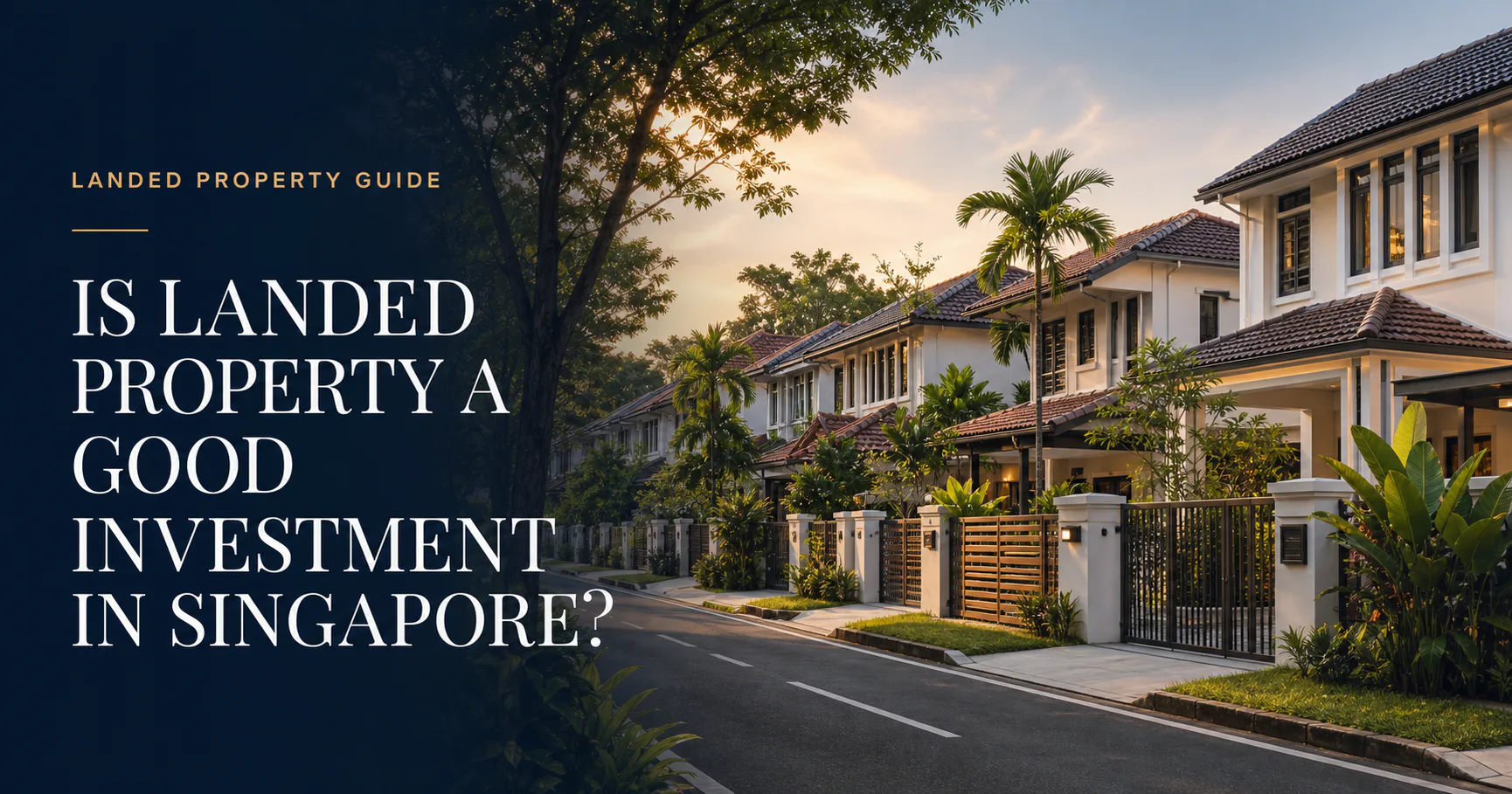
Landed property occupies a special place in Singapore’s housing market. The supply is limited, the lifestyle is difficult to replicate in a condominium, and direct ownership of land can be attractive over a long holding period.
That does not make every landed house a good investment.
A landed purchase combines at least two assets: the land and the building on it. The land may become more valuable while the house itself ages and requires substantial spending. Rental yield can be modest. Renovation or reconstruction may cost more and take longer than expected. When it is time to sell, the buyer pool is smaller than for a mass-market condominium.
The useful question is therefore not whether landed property is “good” in the abstract. It is whether a particular house, at a particular price, suits your finances, intended use and holding period better than the alternatives.
This guide explains how I would frame that decision.
The different types of housing in Singapore carry distinct ownership rules, tenure profiles and investment characteristics. Landed homes should therefore be assessed as one asset class within a broader market that also includes HDB flats, executive condominiums, private apartments and strata landed homes—not automatically as the final rung on a property ladder.
URA’s final figures show landed-property prices rose 2.5% in the second quarter of 2026 after declining 0.4% in the first quarter. One strong quarter does not establish a reliable future return. URA also advises households to remain prudent when purchasing property and taking on housing debt. The decision should work without relying on the latest quarter being repeated.
The short answer
Landed property can be a good long-term purchase when:
- you value the home as a place to live, not only as a yield-producing asset;
- you can hold through slower transaction periods;
- the purchase leaves enough liquidity for repairs, renovation and unexpected works;
- the site, tenure, access and planning constraints have been properly checked;
- the entry price is supportable against relevant transactions rather than scarcity alone; and
- the eventual buyer pool is clear.
It is less convincing when:
- most of your wealth would be concentrated in the purchase;
- you need strong rental cash flow;
- the plan depends on a quick resale;
- the house requires major works that have not been costed properly;
- you are paying for land or redevelopment potential you may not be able to use; or
- a well-chosen condominium would meet the same family needs with greater liquidity and less operational risk.
The buyer has comfortable financial capacity, wants a freehold family home and can hold through slower transaction periods.
The purchase consumes most available capital, depends on strong rental income or requires a quick resale.
Landed should meet a real family and ownership objective—not simply feel like the next rung on a property ladder.
The landed-versus-condo choice is not a contest between a superior and inferior property type. It is a capital-allocation decision with very different trade-offs.
Why landed property attracts buyers
Direct exposure to scarce land
The central attraction is straightforward: a conventional landed home gives the owner direct exposure to a specific parcel of land. Singapore cannot create many new landed enclaves without giving up other land uses, so established landed housing has a scarcity characteristic that most condominiums do not share in the same way.
Scarcity supports the long-term case, but it does not remove price discipline. A property can be scarce and still be overpriced. Awkward access, poor plot shape, road noise, restrictive planning conditions, lease decay or a building near the end of its useful life can materially affect value.
Space, privacy and control
For owner-occupiers, part of the return is not financial. Landed living can provide more privacy, direct access from street to home, flexible living areas, room for multigenerational use and greater control over alterations.
That lifestyle value is real even though it does not appear in a rental-yield calculation. A family that would otherwise buy a large premium condominium may rationally accept a lower yield in exchange for land, privacy and the ability to adapt the home over time.
The danger is paying for an imagined lifestyle without testing the practical one. Stairs, security, pest control, roof and drainage maintenance, heat, parking and daily cleaning all feel different from condominium living.
Potential to improve the property
Some buyers see an older house as a way to create value through renovation, additions and alterations, or reconstruction. That opportunity can exist, but the scope is property-specific.
URA’s current controls cover matters such as plot size, site coverage, setbacks, building envelope and allowable height. Works that exceed the criteria for additions and alterations may be treated as reconstruction. Existing non-conforming structures may also require specific professional assessment.
Never price a house on the assumption that it can automatically become the building you have in mind. A Qualified Person should assess what can actually be approved before the renovation potential is capitalised into your offer.
Heavy customisation also creates a resale trade-off. A home designed closely around one owner’s routines, aesthetic or multigenerational arrangement may work exceptionally well for that family but appeal to a much narrower future audience. The more specialised the layout and finishes become, the more carefully the buyer should distinguish personal utility from recoverable investment value.
What the latest market data does—and does not—tell us
URA reported that landed-property prices increased by 2.5% in 2Q2026, following a 0.4% decline in 1Q2026. By comparison, non-landed prices declined by 0.1% in 2Q after rising 1.3% in 1Q.
Those movements show that landed and non-landed property do not always move together from quarter to quarter. They do not prove that landed homes will outperform over your personal holding period.
Three reasons to avoid overinterpreting the latest index are:
- Landed homes are heterogeneous. A terrace house, semi-detached house and bungalow can behave differently, while two homes on the same street may have different plots, conditions and redevelopment potential.
- The index does not include your ownership costs. Stamp duty, interest, property tax, insurance, repairs, renovation and selling costs affect the return you actually receive.
- Your entry and exit matter more than an average. Paying too much for an inferior plot can overwhelm a favourable market trend.
Use the index as market context. Use comparable transactions, physical due diligence and a full cost plan to make the purchase decision.
Capital appreciation: separate land value from building value
The phrase “landed property appreciates” hides an important distinction.
The land may gain value because of scarcity, location and demand. The physical house usually ages. Unless it is maintained or upgraded, buyers may discount the building or treat it as a future renovation or reconstruction cost.
This creates three broad purchase types:
| Purchase type | What you are mainly buying | Main risk |
|---|---|---|
| Move-in-condition home | Land plus a building with immediate utility | Paying a large renovation premium that future buyers may not value equally |
| Older but serviceable house | Land plus a usable building with future works | Underestimating repairs and the timing of major expenditure |
| Rebuild candidate | Primarily the site and redevelopment opportunity | Planning, design, construction, financing and timing risk |
A renovated house is not automatically worth its renovation cost. Highly personal finishes, inefficient additions or work completed without the right approvals may not translate into an equivalent resale premium.
For investment analysis, ask what proportion of the price is supported by the land, what the current building is worth to you, and what another buyer is likely to pay for it later.
Rental yield: usually not the strongest part of the case
Landed property can be rented, but it should not automatically be treated as a superior income asset.
The total purchase quantum is high, tenant demand is narrower, and upkeep remains the owner’s responsibility. A house can command substantial monthly rent and still produce an unremarkable gross yield once measured against its value.
Net yield is more useful than headline rent:
Net rental yield = annual rent minus vacancy, property tax, insurance, repairs, agent fees and other ownership costs, divided by total capital committed.
That denominator should include more than the purchase price. Applicable stamp duties, legal fees and initial works are part of the capital required to put the property into service.
Landed rental may still make sense where the house has a strong family-tenant catchment, functional bedrooms, practical parking, good condition and a location valued by the intended tenant pool. But if income is the main objective, compare the net return with condominiums at the same total capital commitment.
The costs buyers commonly underestimate
1. Stamp duties and acquisition costs
Buyer’s Stamp Duty and ABSD in Singapore can be material at landed-property price points, with the final amount depending on the transaction value, buyer profile and existing property ownership. Legal fees, valuation costs and immediate building work should also be included in the acquisition budget. Verify the prevailing tax position with IRAS before committing.
2. Financing and opportunity cost
The mortgage is only one part of affordability. A larger down payment and ongoing interest reduce the capital available for business, investments, retirement or other property choices.
Stress-test the purchase under a higher interest rate than the initial package. Also test a period with no rental income, an unexpected repair and a slower sale. If one of those events would force a disposal, the property is probably consuming too much liquidity.
3. Inspection, repair and replacement
Roofs, waterproofing, drainage, retaining walls, plumbing, electrical systems, air-conditioning, gates and external finishes sit with the owner. The absence of a monthly condominium maintenance fee does not mean the house is inexpensive to maintain. It means the expenditure is less regular and can arrive in larger amounts.
Before purchase, the condition assessment should be appropriate to the age and complexity of the house. A general viewing is not a building survey.
4. Renovation, A&A or reconstruction
These are different levels of work with different cost, approval and execution implications. Under URA’s current guidelines, additions and alterations generally involve thresholds including no more than 50% additional approved gross floor area, external-wall replacement and structural change. Proposals outside the criteria may be considered reconstruction.
The investment model should include professional fees, approvals, temporary accommodation, financing during works, contingencies and the cost of delay—not only the contractor’s headline quotation.
Customisation should also be assessed as consumption as well as investment. A highly individual floor plan, specialist room or distinctive finish may improve the present owner’s daily life without adding the same amount to resale value. In extreme cases it can make the house too niche, leaving the next buyer to pay for changes before the home suits them.
5. Property tax and holding costs
Owner-occupied residential properties receive lower progressive property-tax rates. A non-owner-occupied residential property is taxed under a separate, higher schedule. IRAS assesses tax using Annual Value rather than purchase price.
For 2026, owner-occupied private homes also receive a one-off 10% property-tax rebate capped at S$500. That temporary rebate should not be built into a long-term return assumption.
Eligibility is the first filter, not a footnote
Singapore citizens can generally purchase landed residential property subject to the usual transaction rules. A person who is not a Singapore citizen is considered a foreign person under the Residential Property Act and generally requires approval to purchase restricted landed residential property, including at Sentosa Cove.
SLA says applications are assessed case by case. Its stated considerations include being a Singapore Permanent Resident for at least five years and making an exceptional economic contribution to Singapore. SLA also advises buyers to apply early and notes an estimated assessment time of about 30 working days once all relevant information is received.
Some property types—such as a strata landed house within an approved condominium development—may be treated differently. Eligibility should be confirmed for the exact property before entering a binding commitment.
Freehold versus leasehold landed: tenure is not the whole decision
Freehold landed property attracts buyers who want long-duration land exposure and do not want the investment case tied to a declining lease. That can support a broader long-term preservation argument.
But freehold status does not repair a weak plot or an excessive price. A well-located leasehold house bought at a sensible discount may suit a family better than a freehold alternative with poor access, condition or configuration.
For a leasehold landed home, consider:
- the unexpired lease at purchase and at your expected exit;
- whether financing and CPF use may become more restrictive for a future buyer;
- the remaining buyer pool at the intended resale date;
- the discount to a meaningful freehold alternative; and
- whether the planned holding period captures enough utility to justify the lease consumption.
For a freehold home, consider whether the premium is so large that it reduces future returns or compromises your liquidity.
Tenure matters. Entry price, utility and exit demand still matter with it.
Landed versus condo: where each can be stronger
| Decision factor | Landed property may be stronger when… | Condominium may be stronger when… |
|---|---|---|
| Lifestyle | Privacy, space and control are central priorities | Facilities, security and low-friction upkeep matter more |
| Capital exposure | You want direct land exposure and can hold long term | You prefer a smaller quantum or diversified capital allocation |
| Rental | A specific family-tenant catchment supports the house | Broad tenant demand and yield are more important |
| Liquidity | You can accept a smaller, property-specific resale pool | You may need a quicker or more standardised exit |
| Maintenance | You are comfortable managing the entire property | You prefer shared upkeep through an MCST |
| Renovation | You want and can finance substantial customisation | You want a completed home with more predictable work |
| Valuation | You can assess plot, condition and planning potential carefully | You prefer more frequent same-project comparables |
For the same budget, do not compare only floor area. Compare total cash required, usable space, condition, tenure, monthly outflow, future expenditure and likely resale demand.
A landed house may provide more autonomy but less liquidity. A large condo may offer less land exposure but a more transparent transaction market and a broader pool of future buyers. Neither outcome is automatic.
Seven checks before treating a landed home as an investment
These seven checks matter more than a general claim that landed homes are scarce or historically resilient.
1. What exactly supports the asking price?
Use recent and relevant transactions, then adjust for land area, tenure, road, plot shape, orientation, condition and redevelopment potential. A nearby sale is not necessarily comparable merely because it shares a postal sector.
2. Is the plot straightforward?
Check access, frontage, shape, level, drainage, road category, setbacks, easements and any planning or conservation constraints. These affect both daily use and what can be built.
3. What is the building worth in its present condition?
Decide whether you are paying for a finished home, a usable interim building or a teardown. Do not pay a move-in-condition premium and then budget for reconstruction.
4. Can your intended works actually be carried out?
Obtain professional advice before assuming additional floor area, a new storey, subdivision, a basement or a change in housing form. URA controls and site-specific conditions determine what is possible.
5. What is the all-in five- and ten-year cash requirement?
Include duties, interest, tax, insurance, routine upkeep, major works and selling costs. Then compare the result with a condominium and with retaining more liquid investments.
6. Who is the future buyer?
The eventual buyer may want a finished house, a land-value purchase or a rebuild opportunity. A property that sits awkwardly between those groups can be harder to price and sell.
7. Does the decision still work without optimistic appreciation?
If the purchase only makes sense with rapid price growth, it is speculation rather than a resilient housing plan. The base case should be acceptable even if prices are flat for a period.
Who landed property can suit
I am most likely to recommend landed over a condominium when three conditions come together: the buyer genuinely has the budget, wants a freehold property and is purchasing a home for the family.
“Has the budget” means more than qualifying for the mortgage or producing the down payment. The purchase should leave enough liquidity for stamp duty, repairs, renovation and the family’s other priorities. “Wants freehold” should reflect a real preference for long-term ownership rather than an assumption that tenure alone guarantees a better return. And “for the family” matters because space, privacy and control over the home are where landed living can deliver value that a yield calculation does not capture fully.
With that foundation, landed ownership can be particularly suitable for:
- families planning to remain in one home for a long period;
- multigenerational households that genuinely need adaptable space;
- buyers with sufficient liquidity after completion and renovation;
- owner-occupiers who place meaningful value on privacy and control;
- buyers able to evaluate a site rather than relying only on interior presentation; and
- investors prepared to accept lower income in exchange for long-duration land exposure.
Who should be cautious
Exercise particular caution if:
- the purchase consumes nearly all available capital;
- you are stretching to buy landed mainly because it feels like the “next step”;
- you have not budgeted for major building works;
- you need a high rental yield or predictable monthly costs;
- your likely holding period is short;
- eligibility or ownership approval is unresolved; or
- the investment thesis depends on an unverified redevelopment assumption.
There is no failure in choosing a better-quality condo over a compromised landed house. Property type should follow the household’s objective, not become the objective itself.
My view
I would consider landed ahead of a condominium when the buyer has the financial capacity to own it comfortably, wants a freehold home and is making the decision around the family’s long-term needs. In that situation, the additional space, privacy, control and land ownership can justify accepting more maintenance and less liquidity.
The best landed purchases are still not justified by a slogan. They work because the buyer has matched the site, building, price and holding period to a real family objective.
Scarcity is a meaningful long-term support, but it does not protect a buyer from an excessive entry price, poor due diligence or an impractical house. Rental income may soften the holding cost, but landed property is rarely compelling on yield alone. Renovation can create utility and sometimes value, but it also introduces a second investment decision after the acquisition.
I would approach landed property as a long-horizon, high-concentration asset with substantial lifestyle utility. For the right household, that can be a very good combination. For a buyer who needs liquidity, income and simpler ownership, a condominium may be the more disciplined choice.
The final decision should be made property by property.
Frequently asked questions
Is landed property always a better investment than a condo?
No. Landed property offers direct land exposure and scarcity, while condominiums can offer stronger rental liquidity, lower entry quantum and a broader resale pool. Entry price, location, condition and holding period can matter more than property type.
Does landed property have good rental yield?
It can generate substantial rent, but the gross yield may be modest relative to the total property value. Net yield should account for vacancy, tax, insurance, repairs, agent fees and the capital spent on initial works.
Is freehold landed property always worth the premium?
Not automatically. Freehold tenure can support long-term land-value preservation, but buyers should still assess the premium, plot quality, condition, location and alternative use of the capital.
Can a Singapore Permanent Resident buy landed property?
A non-Singapore citizen generally needs approval under the Residential Property Act to purchase restricted landed residential property. SLA assesses applications case by case. Confirm eligibility and approval requirements for the exact property before committing.
Should I buy an old landed house and rebuild it?
Only after checking the site, planning controls, likely construction scope, professional fees, financing, temporary accommodation and contingency. The apparent discount on an old house can disappear if the project is under-budgeted or delayed.
How long should I hold landed property?
There is no universal period, but the high transaction costs, property-specific resale market and potential renovation expenditure favour a longer horizon. Residential properties acquired on or after 4 July 2025 can also attract Seller’s Stamp Duty if disposed of within four years, at rates that step down from 16% to 4%.
Share your budget, preferred areas, current property position and expected holding period. I can help you compare the landed option with relevant condominiums, examine the full ownership cost and identify the questions that should be resolved before you commit.