Last Updated on September 25, 2026
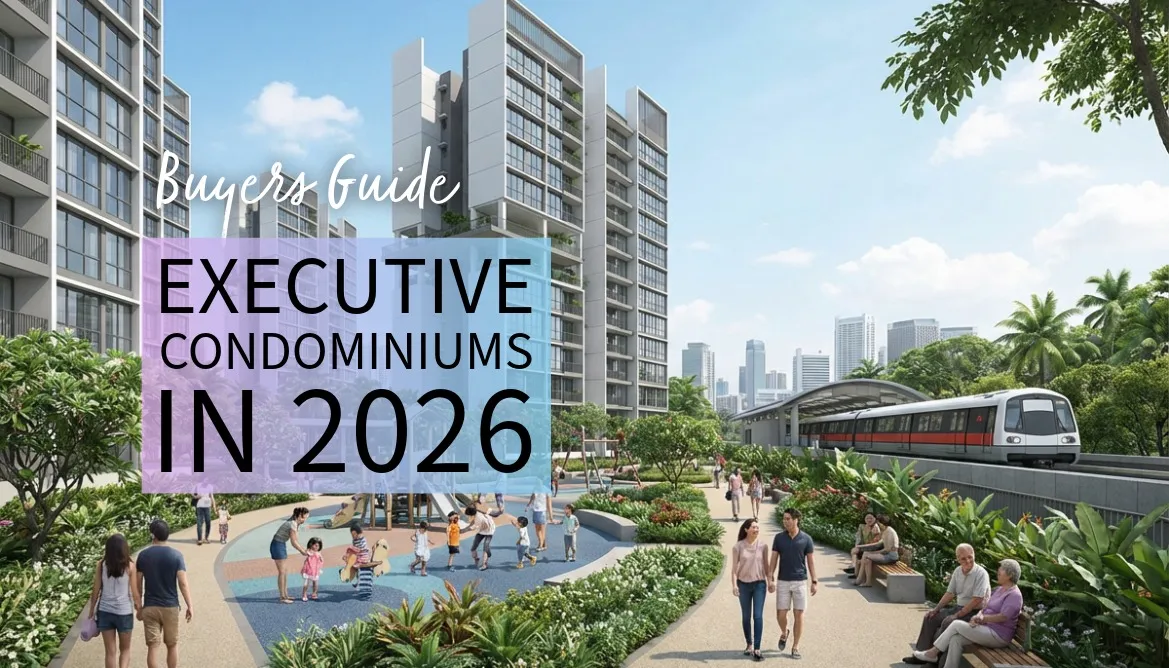
Executive Condominiums (ECs) sit in a very specific sweet spot in Singapore’s housing market. In 2026, they are gaining renewed visibility and supply after a period of relatively fewer headline new launches.
Built by private developers but sold with Housing & Development Board (HDB)-style restrictions in their early years, ECs are primarily designed for upgraders and young families who want a private condo lifestyle without stretching their finances too aggressively. They start life as a hybrid product, then gradually transition into fully private property after ten years for projects under the earlier EC framework, or after fifteen years for projects where the land-sales tender closed on or after 8 May 2026.
For buyers weighing their next move — whether from a resale HDB flat, a first home purchase, or a long-term upgrade plan — ECs often represent the most balanced option. They typically launch at prices 20–30 percent below comparable private condos, yet still offer modern layouts, facilities, and long-term capital upside.
Understanding how ECs compare with Build-To-Order (BTO) flats, resale HDB flats, private condominiums, and landed homes helps clarify their position within Singapore’s broader housing landscape.
Quick Summary for EC Buyers in 2026
Short answer: ECs remain attractive for eligible Singapore households, but the 2026 rule changes make it more important to check each project’s land tender date before comparing income ceilings, Minimum Occupation Period (MOP), full privatisation timeline, and payment options.
- Income ceiling: The monthly household income ceiling remains $16,000 for balance units in existing ECs and new EC projects with land-sale tenders awarded before 24 August 2026. For new EC units in projects with land-sale tender closing dates on or after 24 August 2026, the ceiling is $18,000.
- MOP: Earlier-framework ECs generally have a 5-year MOP. EC projects where the land-sales tender closed on or after 8 May 2026 have a 10-year MOP.
- Full privatisation: Earlier-framework ECs generally become fully private after 10 years. Newer affected ECs only become fully private after 15 years.
- Launch status: Coastal Cabana and Rivelle Tampines have already launched in 2026, while Senja Close, Sembawang Road, Miltonia Close, and two Woodlands Drive 17 parcels form part of the late-2026 and 2027 EC pipeline.
- Payment structure: The Deferred Payment Scheme (DPS) remains relevant for earlier-framework ECs where offered by developers, but it is removed for affected future GLS projects under the newer EC framework.
Contents
- How ECs compare to other property types
- EC eligibility rules in 2026
- 2026 EC policy changes
- How to buy an EC in 2026
- Current EC launch status and pipeline
- Affordability and cash-flow framework
- Past EC performance
- Key risks before buying
- Frequently asked questions
How Executive Condominiums Compare to Other Property Types
Executive Condominiums occupy a distinct middle ground within Singapore’s housing landscape. While they are developed and managed like private condominiums, ECs are subject to HDB eligibility rules at launch, which keeps entry prices more accessible for eligible buyers.
Compared to BTO and resale HDB flats, ECs offer private-style facilities, newer designs, and longer-term upside once resale restrictions fall away. In contrast to private condominiums, ECs typically start at lower launch prices but come with conditions such as income ceilings, a Minimum Occupation Period, and a longer path to full privatisation.
This hybrid structure makes ECs particularly appealing to HDB upgraders who are planning ahead. Buyers who understand how ECs transition over time — from subsidised housing to fully private property — are better positioned to decide whether an EC fits their budget, timeline, and long-term plans.

ECs function as a stepping stone. Buyers enjoy private-grade facilities and layouts while keeping monthly expenses manageable during the early stages of family building and career progression.
EC Eligibility Rules in 2026
Short answer: EC buyers must satisfy HDB’s citizenship, family nucleus, income ceiling, property ownership, and MOP rules. The exact income ceiling and lock-in period now depend heavily on the EC project’s land-sale tender date.
Because ECs are subsidised, buyers must meet specific eligibility requirements and obtain a valid HDB Flat Eligibility (HFE) letter before Booking Day. EC purchases are subject to HDB eligibility checks.
1. Citizenship Requirements
At least one applicant must be a Singapore Citizen.
The other applicant must be either a Singapore Citizen or a Permanent Resident.
2. Family Nucleus Requirements
Buyers must qualify under one of the following schemes:
- Public Scheme
- Fiancé/Fiancée Scheme
- Orphan Scheme
- Joint Singles Scheme for resale ECs only
3. Income Ceiling
Monthly household income must not exceed $16,000 for balance units in existing ECs and new EC projects with land-sale tenders awarded before 24 August 2026, while the ceiling is $18,000 for new EC units in projects with land-sale tender closing dates on or after 24 August 2026.
4. Property Ownership Rules
- No ownership of local or overseas private property within the required period before applying.
- No disposal of private property within the 30-month period just to qualify, where the prevailing EC rules apply.
- Existing HDB flat owners must dispose of their HDB flat within the required timeframe after taking possession of the EC, and applicants must also comply with the separate local and overseas private-property ownership rules.
5. Minimum Occupation Period (MOP)
- Minimum 5 years before selling on the open market for projects under the earlier EC framework, and 10 years for EC projects where the land-sales tender closed on or after 8 May 2026.
- 10 years before selling to foreigners for EC projects under the earlier framework, or 15 years for projects where the land-sales tender closed on or after 8 May 2026.
Most EC buyers upgrade after completing MOP on their first flat, aligning with the typical resale timeline HDB owners go through before their next move.
2026 EC Policy Changes: 10-Year MOP, 15-Year Privatisation and $18,000 Income Ceiling
Short answer: The key 2026 EC policy changes affect newer EC projects differently from earlier-framework launches. Buyers should always check the land-sales tender closing date before assuming the MOP, income ceiling, privatisation timeline, or payment scheme.
| Rule Area | Earlier EC Framework | Newer Affected EC Framework |
|---|---|---|
| Minimum Occupation Period | 5 years from Temporary Occupation Permit (TOP) | 10 years for EC projects where the land-sales tender closed on or after 8 May 2026 |
| Full Privatisation | After 10 years | After 15 years for EC projects where the land-sales tender closed on or after 8 May 2026 |
| Income Ceiling | $16,000 for balance units in existing ECs and new EC projects with tenders awarded before 24 August 2026 | $18,000 for new EC units in projects with land-sale tender closing dates on or after 24 August 2026 |
| Deferred Payment Scheme | May be available where offered by the developer | Removed for affected future GLS projects under the newer framework |
| First-Timer Priority | Standard first-timer priority rules apply | Higher first-timer priority applies for affected future EC launches |
These changes are especially important for buyers comparing an EC balance unit, a launched 2026 EC, and a future Government Land Sales (GLS) site. Two projects may both be called Executive Condominiums, but the holding period and eventual resale audience can be very different.
How to Buy an EC in 2026: Step-by-Step
Short answer: Buying an EC is more structured than buying a typical private condo. The process usually starts with eligibility and financing checks before moving into e-application, balloting, booking, and the Sale & Purchase Agreement.
- Check eligibility early. Confirm citizenship, family nucleus, income ceiling, property ownership status, and whether you are a first-timer or second-timer applicant.
- Apply for the HFE letter where required. The HFE letter helps assess housing eligibility and should be prepared before the EC booking stage.
- Work out affordability. Check CPF usage, cash requirement, bank loan amount, Buyer’s Stamp Duty (BSD), resale levy exposure, and monthly repayment comfort.
- Submit an e-application during preview. Developers usually prioritise buyers who submit an e-application during the preview period and receive a queue number.
- Review prices and unit availability. Compare stacks, facing, floor level, unit size, quantum, and future resale appeal instead of focusing only on psf.
- Attend balloting or booking. Booking procedures can vary by project, and remaining units may later be handled on a first-come, first-served basis.
- Pay the option fee and sign the Sale & Purchase Agreement. After booking, buyers proceed with legal documentation, financing, stamp duty payment, and progressive payments according to the project timeline.
Current EC Launch Status and Pipeline
After a period of softer EC launch activity, 2026 has become a more active year for buyers, led by Coastal Cabana and Rivelle Tampines, with additional EC sites such as Senja Close, Sembawang Road, Miltonia Close, and two Woodlands Drive 17 parcels forming the late-2026 and 2027 pipeline.
For Executive Condominium launches, buyers normally submit an application during the preview period to receive a queue number and be eligible to book on Booking Day. Developers usually prioritise buyers who submit an e-application during the preview period and receive a queue number, but booking procedures can vary by project and remaining units may later be handled on a first-come, first-served basis.
| Project / Site | Location | Developer | Units | Launch / Expected Timing | Status | Average Launch Price | Likely EC Framework |
|---|---|---|---|---|---|---|---|
| Coastal Cabana EC | Pasir Ris | Qingjian Realty and Forsea Holdings | 748 | Launched 17 January 2026 | About two-thirds sold during opening weekend | About $1,734 psf | Earlier framework: 5-year MOP and 10-year full privatisation |
| Rivelle Tampines EC | Tampines North / Tampines Street 95 | Sim Lian Group | 572 | Launched in March 2026 | Fully sold within a month of launch | About $1,893 psf at launch | Earlier framework: 5-year MOP and 10-year full privatisation |
| Senja Close EC GLS | Bukit Panjang | To be confirmed by tender outcome and developer timeline | To be confirmed | Late-2026 / 2027 pipeline | Upcoming | To be confirmed | Check land tender closing date |
| Sembawang Road EC GLS | Sembawang / Canberra | To be confirmed by tender outcome and developer timeline | To be confirmed | 2026 pipeline, subject to developer timeline | Upcoming | To be confirmed | Check land tender closing date |
| Miltonia Close EC GLS | Yishun / Lentor fringe | To be confirmed by tender outcome and developer timeline | To be confirmed | Late-2026 / 2027 pipeline | Upcoming | To be confirmed | Check land tender closing date |
| Woodlands Drive 17 EC parcel by CDL | Woodlands | CDL | To be confirmed | Expected around late 2026, subject to developer timeline | Upcoming | To be confirmed | Check land tender closing date |
| Woodlands Drive 17 EC parcel by Sim Lian | Woodlands | Sim Lian | To be confirmed | Expected around 2027, subject to developer timeline | Upcoming | To be confirmed | Check land tender closing date |
Coastal Cabana EC (Pasir Ris)
Located near Pasir Ris Park and Downtown East, this project offers a strong family-centric lifestyle appeal.
Show Flat Preview: Coastal Cabana previewed from 6–21 December 2025 and launched for booking on 17 January 2026.
Launch status: Coastal Cabana launched on 17 January 2026 and sold about two-thirds of its 748 units during its opening weekend at an average price of about $1,734 psf.
Key highlights
- Close to Pasir Ris MRT and integrated developments
- Coastal leisure environment
- Particularly attractive to larger families in the east
Lifestyle-driven locations like this often behave similarly to neighbourhoods where accessibility and amenities intersect, as seen in areas analysed around Bright Hill and Ai Tong MRT.
Rivelle Tampines EC (Tampines North)
Launch status: Rivelle Tampines launched in March 2026 and was fully sold within a month of its launch.
Tampines remains one of Singapore’s most established regional centres, and ECs here have historically attracted strong demand from upgraders. Buyers are drawn to the area’s depth of amenities, proximity to schools, and the long-term connectivity upside from the upcoming Cross Island Line.
Key highlights
- Proximity to schools
- Full range of mature-town amenities
- Upcoming Cross Island Line connectivity
Transformation-driven districts often exhibit buyer behavior similar to established lifestyle hubs, such as the Great World City area, where convenience continues to underpin demand.
Woodlands Drive 17 EC GLS
Woodlands Drive 17 has two EC parcels in the pipeline: one by CDL and one by Sim Lian, so buyers should compare each site’s developer, unit count, expected launch timing, and applicable EC policy framework separately.
Expected booking window: The CDL Woodlands Drive 17 parcel is expected around late 2026, while the Sim Lian Woodlands Drive 17 parcel is expected around 2027, subject to developer timelines.
Woodlands continues to undergo a major transformation as a regional hub, supported by transport infrastructure and employment nodes. These EC sites are likely to appeal to buyers prioritising long-term growth potential and relative affordability compared to more central locations.
Key highlights
- Long-term growth potential
- Near Woodlands South on the Thomson-East Coast Line
- Expected to offer more accessible entry pricing
This mirrors patterns seen in URA’s quarterly private residential data, where well-connected fringe regions demonstrate steady long-term demand.
Sembawang Road EC GLS
Expected booking window: 2026 pipeline, subject to tender outcome and developer launch timeline.
Sembawang has consistently produced well-performing ECs due to its affordability and steady demand for upgraders from nearby HDB estates. Improved transport connectivity in the north has further supported buyer interest in recent EC launches within the area.
Key highlights
- Near Canberra MRT
- Strong historical EC demand in the north
- Popular with young families upgrading from HDB
Affordability and Cash-Flow Framework
Short answer: EC affordability is not only about whether the headline price looks lower than a private condo. Buyers should assess option fee, down payment, CPF usage, bank loan limits, Buyer’s Stamp Duty, resale levy, progressive payments, and monthly repayment comfort.
| Cost Area | What Buyers Should Check | Why It Matters |
|---|---|---|
| Option fee | Cash payable when booking the EC unit | Confirms commitment and starts the purchase timeline |
| Down payment | Cash and CPF split based on loan structure | Affects upfront liquidity |
| Bank loan | Loan-to-value limit, Total Debt Servicing Ratio, interest rate, and loan tenure | Determines maximum loan and monthly instalments |
| CPF usage | CPF Ordinary Account funds available for down payment, stamp duty, and monthly instalments | Reduces cash outlay but affects retirement balances |
| Buyer’s Stamp Duty | BSD payable based on purchase price or market value, whichever is higher | Often a sizeable upfront cost |
| Resale levy | Whether the buyer previously enjoyed a housing subsidy | Can materially affect second-timer affordability |
| Progressive payment | Whether payments follow construction milestones | Important for cash-flow planning before TOP |
| Deferred Payment Scheme | Whether DPS is available for the project | Can help some HDB upgraders bridge timing, but may come with a higher purchase price |
For first-timer families, the main focus is usually entry affordability, CPF grant eligibility where applicable, and long-term monthly repayment comfort. For HDB upgraders, the key questions are more often timing-related: when to sell the existing flat, whether a resale levy applies, how much CPF can be refunded and reused, and whether the family can handle the transition before collecting EC keys.
Review of Past ECs Performance: What History Tells Us
To determine whether ECs remain a smart investment in 2026, it is helpful to examine how previous projects have performed after reaching MOP.
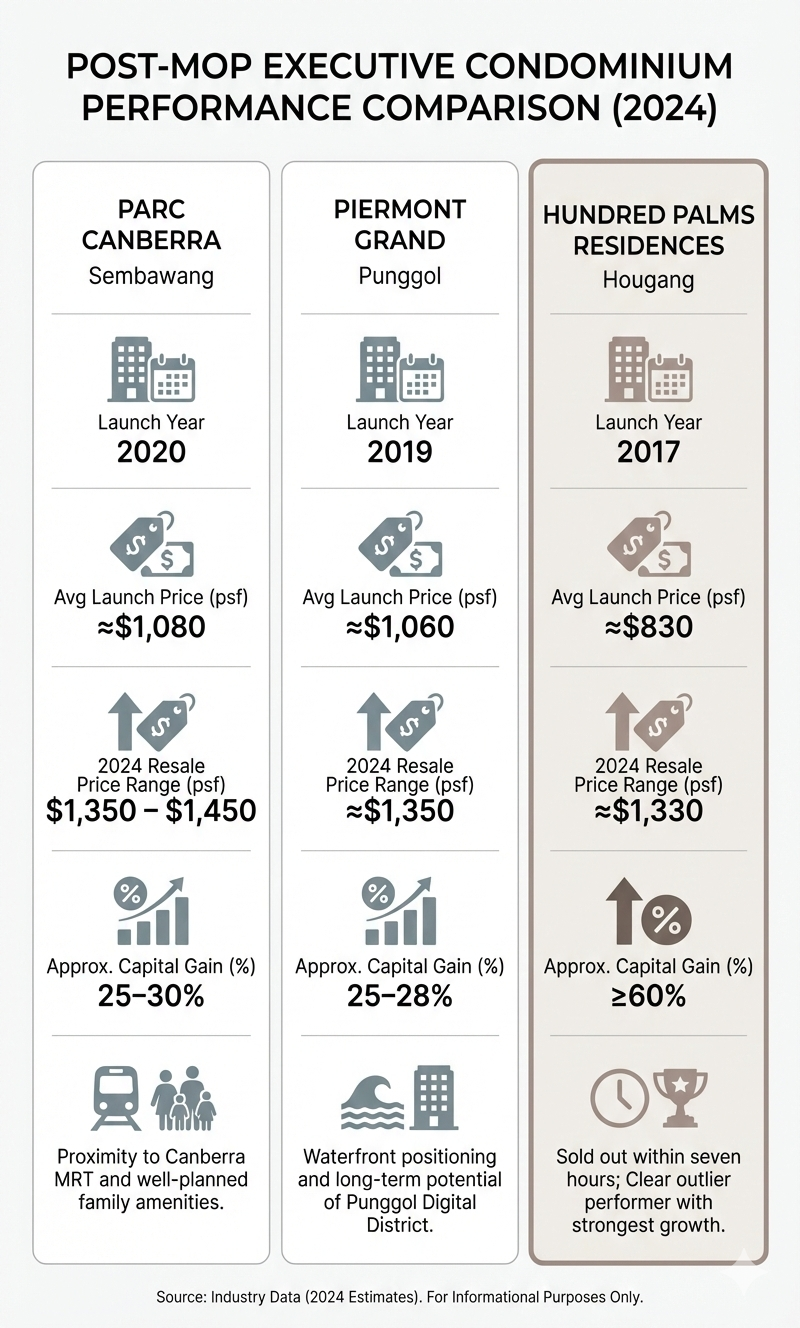
This comparison should focus on Executive Condominiums that have already reached MOP, so buyers can assess actual resale performance after restrictions are lifted. Older post-MOP ECs such as Hundred Palms Residences, iNz Residence, NorthWave, Treasure Crest, The Visionaire, Sol Acres, Parc Life, The Criterion, and The Brownstone provide more suitable evidence of how EC resale prices can behave after resale restrictions are lifted.
| Project | Location | TOP / MOP Context | Launch Price Context | Post-MOP Resale Context | What Buyers Can Learn |
|---|---|---|---|---|---|
| Hundred Palms Residences | Yio Chu Kang / Hougang | Reached MOP after TOP in 2019 | Known for a very competitive entry price at launch | Post-MOP resale transactions have reflected strong upgrader demand | Low entry price and limited competing supply can amplify gains |
| iNz Residence | Choa Chu Kang | Post-MOP EC | More affordable west-region EC entry point | Resale activity shows demand from families seeking condo facilities at a lower quantum | Quantum affordability can matter as much as psf |
| NorthWave | Woodlands | Post-MOP EC | Northern-region EC pricing | Post-MOP resale demand is tied to affordability and Woodlands transformation | Longer-term regional plans can support buyer interest |
| Treasure Crest | Sengkang | Post-MOP EC | Mass-market EC launch pricing | Resale demand supported by a large HDB upgrader catchment | Nearby HDB estates can form a strong future buyer pool |
| The Visionaire | Sembawang / Canberra | Post-MOP EC | Northern-region EC launch pricing | Resale performance supported by Canberra MRT and amenities | Transport improvements can reshape resale perception |
| Sol Acres | Choa Chu Kang | Post-MOP EC | Large-scale EC with varied unit types | Resale results vary by unit size, stack, facing, and entry price | Project scale creates more resale competition within the same development |
| Parc Life | Sembawang | Post-MOP EC | Affordable northern EC entry | Resale interest supported by family-sized units and amenities | Family-friendly layouts remain important after MOP |
| The Criterion | Yishun | Post-MOP EC | Yishun EC launch pricing | Resale activity reflects both affordability and competition from nearby projects | Neighbouring supply can influence exit pricing |
| The Brownstone | Canberra | Post-MOP EC | Launch pricing benefited from earlier market conditions | Post-MOP demand supported by MRT proximity | Accessibility remains one of the strongest resale filters |
Together, these projects illustrate why ECs often appeal to long-term buyers rather than short-term speculators. While outcomes vary by location, timing, and supply conditions, post-MOP performance has generally supported the view that ECs can offer meaningful upside when bought early in the development cycle and held through maturity.
This context is especially relevant for buyers evaluating newer EC launches, as it illustrates how pricing behaviour typically evolves once restrictions are lifted. Parc Canberra and Piermont Grand can still be useful for understanding newer EC pricing and buyer sentiment, but they should not be treated as post-MOP resale examples because they had not completed a five-year MOP by September 2026.
What this means for Executive Condominiums in 2026:
ECs have historically delivered resilient performance due to lower entry prices, limited supply, gradual privatisation, and consistent upgrader demand. However, performance is not automatic. Entry price, project selection, interest rates, competing supply, unit attributes, and holding period all matter.
Key Risks Before Buying an EC
Short answer: ECs can be compelling, but they are not risk-free. The strongest buyers are those who can hold comfortably through the required MOP and are not relying on a quick exit.
- Longer lock-in periods: Newer affected ECs with a 10-year MOP require a much longer commitment before resale flexibility improves.
- 15-year privatisation timeline: For affected newer EC projects, the pool of potential buyers remains more restricted for longer.
- Interest rate risk: Monthly instalments can rise if mortgage rates move up or refinancing options become less favourable.
- High launch prices: A lower price than nearby private condos does not automatically mean the entry price is cheap.
- Rental restrictions: EC owners cannot rely on renting out the whole unit during MOP in the same way they might with a fully private investment property.
- Policy changes: EC rules can change, and future buyer demand may be affected by income ceilings, resale restrictions, grants, and financing conditions.
- Resale timing: Many owners may try to sell around the same MOP window, increasing competition within the same project.
- Appreciation is not guaranteed: Historical EC gains are helpful reference points, but individual resale outcomes can still vary.
Should You Buy an Executive Condominium in 2026? A Practical Buyer’s Framework
ECs tend to work best for buyers who:
- Want private-condo facilities at a subsidised entry price. The price gap between ECs and private condos usually narrows significantly by the time full privatisation occurs.
- Have a long-term horizon of at least five to ten years. Short-term flipping is not possible due to MOP restrictions, and newer affected ECs require an even longer holding mindset.
- Are upgrading from an HDB flat. ECs offer a meaningful lifestyle upgrade with built-in capital growth mechanics, provided the numbers remain comfortable.
- Prefer resilience over speculation. ECs have historically shown stable demand because of regulated supply and sustained interest from upgraders, although individual project performance can vary.
For buyers choosing between HDB, ECs, and private condos, the real decision hinges on eligibility, affordability, and long-term plans rather than lifestyle alone.
Glossary: Key EC Terms
| Term | Meaning |
|---|---|
| EC | Executive Condominium, a hybrid housing type built by private developers but sold with public-housing-style eligibility and resale rules in the early years. |
| HDB | Housing & Development Board, Singapore’s public housing authority. |
| BTO | Build-To-Order flat, a new HDB flat launched directly by HDB. |
| GLS | Government Land Sales, the programme through which land parcels are released for development. |
| HFE | HDB Flat Eligibility letter, used to assess housing eligibility before purchase. |
| MOP | Minimum Occupation Period, the period owners must occupy the property before selling or renting out the whole unit. |
| TOP | Temporary Occupation Permit, the point when a completed development can be occupied. |
| CPF | Central Provident Fund, which can be used for eligible housing payments subject to rules and limits. |
| DPS | Deferred Payment Scheme, a payment structure sometimes offered for earlier-framework ECs, but removed for affected future EC GLS projects under the newer rules. |
Conclusion: 2026 Is a Strong Year for EC Buyers — If You’re Prepared
Executive Condominiums continue to offer one of the most compelling value propositions for Singapore households. As affordability pressures rise, ECs remain a practical pathway into private-style living without over-stretching financially.
With several EC launches and GLS sites shaping the 2026 pipeline, buyers have a wider range of choices compared to recent years, when supply was limited. This creates opportunity — but only for those who understand the rules, timelines, and long-term implications.
You may find 2026 an excellent entry point if you:
- Meet the eligibility criteria
- Understand whether the project falls under the earlier or newer EC framework
- Have a long-term holding plan
- Want private-quality living at a more accessible price
- Value steady capital appreciation over short-term gains
If you’d like a personalised assessment of which 2026 EC best fits your budget, lifestyle, and long-term plans, feel free to reach out. I’ll help you evaluate the options clearly and step-by-step.
Frequently Asked Questions (FAQ)
1. Are ECs still worth buying in 2026?
Yes, for the right buyer profile. ECs remain attractive for eligible households that want private-condo facilities at a more accessible entry price, but buyers should compare the project’s launch price, MOP framework, income ceiling, location, and long-term holding requirements before committing.
2. Who qualifies to buy an EC?
You must meet HDB citizenship, family nucleus, income ceiling, and property ownership requirements. At least one applicant must be a Singapore Citizen, and the other applicant must generally be a Singapore Citizen or Permanent Resident.
3. What is the EC income ceiling in 2026?
The monthly household income ceiling is $16,000 for balance units in existing ECs and new EC projects with land-sale tenders awarded before 24 August 2026. For new EC units in projects with land-sale tender closing dates on or after 24 August 2026, the income ceiling is $18,000.
4. What is the difference between the 5-year and 10-year MOP for ECs?
Earlier-framework ECs generally have a 5-year MOP from TOP. EC projects where the land-sales tender closed on or after 8 May 2026 have a 10-year MOP, which means owners must hold and occupy the unit for longer before selling on the open market.
5. What is the difference between 10-year and 15-year full privatisation?
Earlier-framework ECs generally become fully private after 10 years, allowing sales to foreigners from that point. Newer affected ECs only become fully private after 15 years, so the resale audience remains more restricted for longer.
6. Do ECs usually appreciate after MOP, and what risks should buyers consider?
Historical data show that many ECs have appreciated after MOP, but individual outcomes vary by entry price, location, market cycle, unit attributes, and holding period. Buyers should avoid assuming that every EC will produce the same return.
7. Should I buy an EC or a private condo?
ECs are ideal for long-term owner-occupiers seeking value and who can accept eligibility and resale restrictions. Private condos suit buyers who want immediate rental flexibility, no HDB-style eligibility conditions, and a less restricted resale market from the start.
8. Can singles buy an EC?
Singles generally cannot buy a new EC alone at launch. The Joint Singles Scheme applies to resale ECs, subject to the prevailing rules and the EC’s age and privatisation status.
9. Can second-timers buy an EC?
Yes, second-timers may buy an EC if they meet the eligibility rules. They should check resale levy obligations, quota availability, financing, and timing for selling their existing HDB flat.
10. Can EC buyers use the Deferred Payment Scheme?
The Deferred Payment Scheme may still be available for earlier-framework EC projects where offered by the developer. For affected future GLS projects under the newer EC rules, DPS has been removed.
11. Are renovation costs for ECs high?
Like condos, renovation costs vary by design preference. ECs typically require less initial work compared to older resale flats because they are newer and come with condo-style fittings, but buyers should still budget for carpentry, lighting, appliances, and soft furnishings.